Syllabus: Tasmanian Road Rules Handbook (2026)
TAS DKT: Full Practice Test A
Complete practice set for the Tasmania Driver Knowledge Test.
Part 1: General Knowledge
15 Practice Questions
Part 2: Road Safety
20 Practice Questions
Question Format
Multiple Choice (35 Total)
⚠️ Practice Mode: This is a relaxed study session. You can complete all 35 questions to review the correct answers, even if you make a mistake.
Start Practice Test A
Ready to master the questions?
Why should you keep a larger gap when following a large vehicle?
To reduce wind effect and noise.
To allow the vehicle to maintain speed.
To reduce strain on your vehicle.
To improve visibility and be seen in mirrors.
A larger gap improves your view ahead and ensures you remain visible to the driver of the large vehicle through their side mirrors.
What must you do when entering an active School Zone?
Maintain your normal driving speed.
Slow to the speed limit on the sign.
Slow down only if children are visible.
Speed up to clear the area quickly.
When a school zone is active, you must reduce speed to the signposted limit regardless of whether children are visible.
At this intersection with a green light (no arrow), who must give way to the pedestrian?
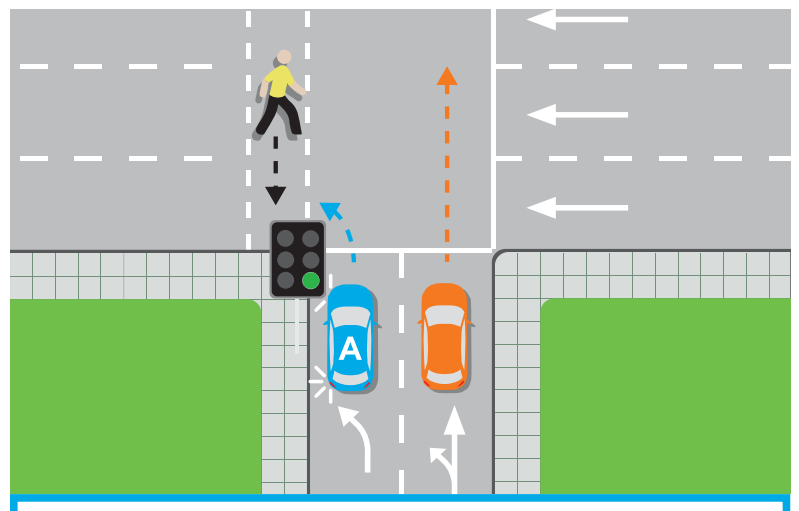
Blue car.
Red car.
Both blue and red cars.
Neither car.
A driver turning left at a green light without an arrow must give way to pedestrians crossing the road being entered.
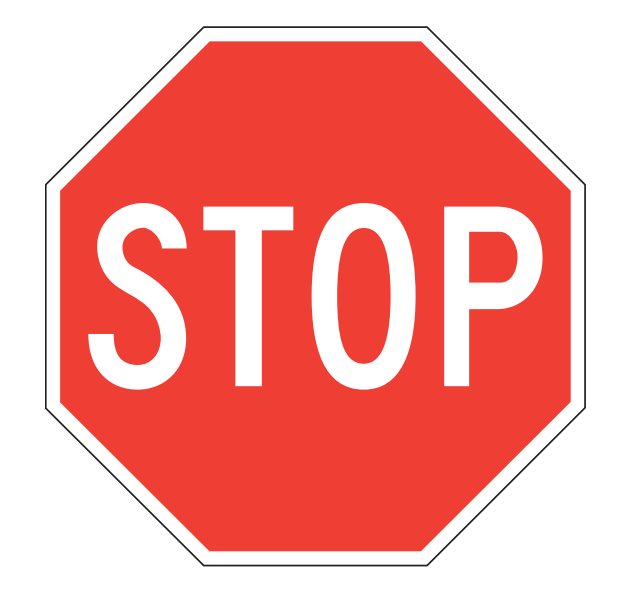
What must you do at a STOP sign?
Slow down and check for traffic.
Stop, check traffic, and give way.
Stop only if vehicles are coming.
Slow and stop only if needed.
You must come to a complete halt regardless of traffic and give way to all vehicles before proceeding.
What is the legal BAC limit for a learner or provisional driver?
0.05.
0.02.
0.00.
0.08.
Learner and provisional drivers must maintain a zero blood alcohol level, as no alcohol is permitted while operating a vehicle.
If your motorcycle starts to wobble at high speed, you should:
Apply brakes firmly to stop the shaking.
Turn handlebars sharply to correct balance.
Accelerate quickly to regain control.
Hold handlebars steady and ease off throttle.
Smoothly reducing speed while keeping the bike steady helps regain control without increasing instability. Sudden braking or acceleration can worsen the wobble.
Why must a motorcycle rider perform a shoulder check before changing lanes?
To confirm traffic distance ahead.
To recheck mirror alignment.
To detect vehicles in blind spots.
To signal your movement clearly.
Mirrors have limitations. A shoulder check is the only way to see vehicles in your blind spots that are not visible in the mirrors.
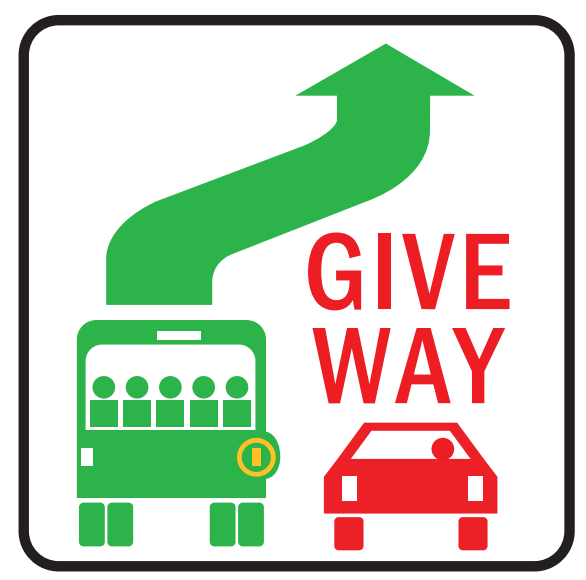
A bus ahead is stopped on the left with its right indicator on, you must:
Give way and allow the bus to merge.
Continue driving and pass the bus.
Sound horn and move ahead.
Overtake quickly before it moves.
When a bus is stopped on the left and signals right to enter traffic, the law requires you to slow down and give way so it can safely rejoin the lane.
On a multi-lane road, where is the safest position for a motorcyclist?
In the center of the lane.
Next to the white lines.
In the left or right wheel tracks.
On the road shoulder.
Riding in the wheel tracks provides better grip and visibility. The center of the lane should be avoided as it often collects oil, grease, and debris from other vehicles.
When must a driver and passengers wear seat belts?
Only when driving on highways.
At all times when the vehicle is moving.
Only when airbags are not available.
Only when traveling above 40 km/h.
Seat belts are required for all occupants whenever the vehicle is moving, regardless of speed or road type.
At an intersection, two vehicles are turning right. How should they pass?
Pass in front of each other.
Pass behind each other.
One waits for the other.
Whoever is faster goes first.
When two vehicles turn right at an intersection, they should pass in front of each other (right-side to right-side) so their paths do not cross and traffic flows smoothly.
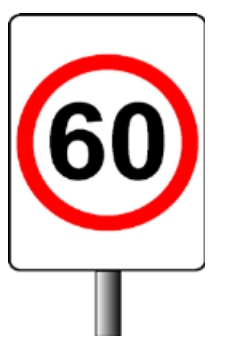
What does this sign mean?
Maximum speed limit is 60 km/h.
Recommended speed is 60 km/h.
Minimum speed limit is 60 km/h.
Average speed should be 60 km/h.
A number inside a red circle indicates the legal maximum speed limit that must not be exceeded.
What must you do when a traffic light turns yellow?
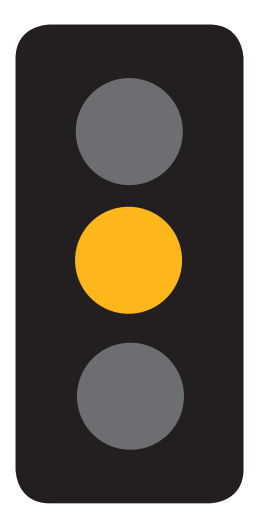
Speed up to clear the intersection.
Stop immediately regardless of traffic.
Continue through without slowing.
Stop if safe; otherwise proceed cautiously.
A yellow light means you must stop unless you are so close that stopping safely is not possible.
What is your first legal duty if involved in an injury crash?
Stop and exchange details first.
Stop and help the injured person.
Move vehicle, then take action.
Call an ambulance immediately.
Your first legal duty is to stop and provide all possible assistance to anyone injured before performing other tasks.
When overtaking a bicycle above 60 km/h, what minimum distance must you keep?
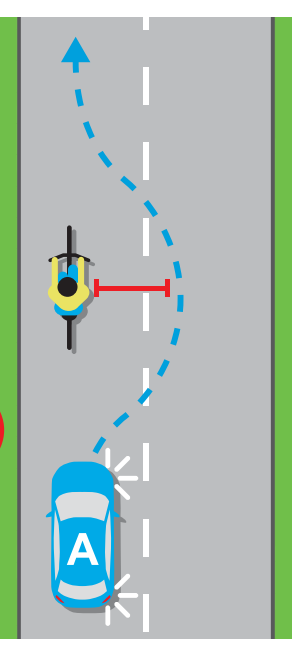
About 2 metres if safe.
At least 1 metre.
At least 1.5 metres.
Any safe distance based on conditions.
At speeds above 60 km/h, you must keep a minimum lateral distance of 1.5 metres when passing a bicycle.
What does a single continuous white line on the left side of the road mean?
No crossing at any time.
It marks the road edge.
It shows the left lane boundary.
It separates opposing traffic.
This line, known as an edge line, defines the road boundary and helps guide drivers within their lane.
If you feel tired or sleepy while driving, you should:
Drink coffee and continue driving.
Open the window and drive faster.
Turn the radio up to stay awake.
Pull over in a safe place and rest.
The only effective way to deal with fatigue is to stop in a safe location and rest before continuing your journey.
When driving at night behind another vehicle, you must dip your headlights:
Within 50 metres.
Within 200 metres.
Only if signalled by the driver.
Only when overtaking.
You must dip headlights within 200 metres to avoid dazzling the driver ahead and maintain safe visibility.
At this intersection with green signals, who must give way?
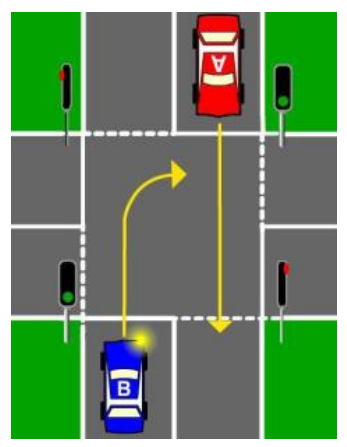
Car A.
Car B.
Both Cars.
Neither Car.
A vehicle turning right must give way to oncoming traffic going straight or turning left before completing the turn.
When riding, how far ahead should you scan the road?
Up to the vehicle ahead.
At least 12 seconds ahead.
A few seconds ahead only.
About 5 meters ahead.
Scanning 12 seconds ahead allows you to spot hazards early and gives you enough time to react safely to changing road conditions.
When changing from one marked lane to another, who must give way?
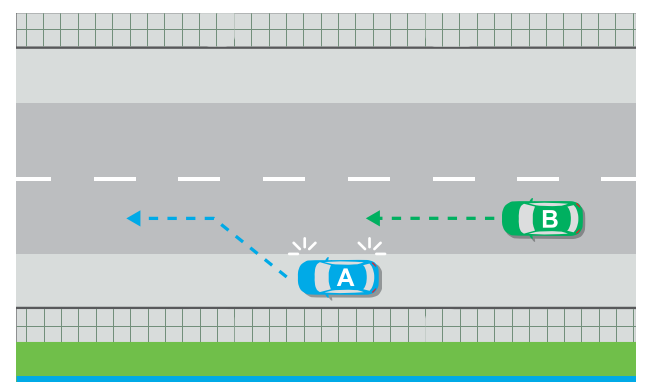
Car A.
Car B.
Both cars.
Neither car.
The driver changing lanes must give way to vehicles already travelling in the lane being entered.
What does this sign indicate?
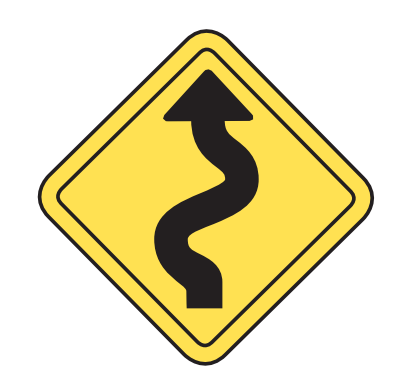
First right then left turn.
Uneven road surface ahead.
Slippery road ahead.
Winding road ahead.
This sign warns of a series of curves ahead without specifying exact directions, so drivers should slow down and be prepared for continuous bends.
What must you do when approaching a crest or curve with limited visibility?
Overtake slow vehicles ahead.
Keep left and drive at a safe speed.
Stay in the middle of the road.
Speed up to clear the curve.
When visibility is limited, you must stay left and maintain a speed that allows you to stop safely for any hidden hazards.
At this intersection, both cars have green signals. Which car must give way?
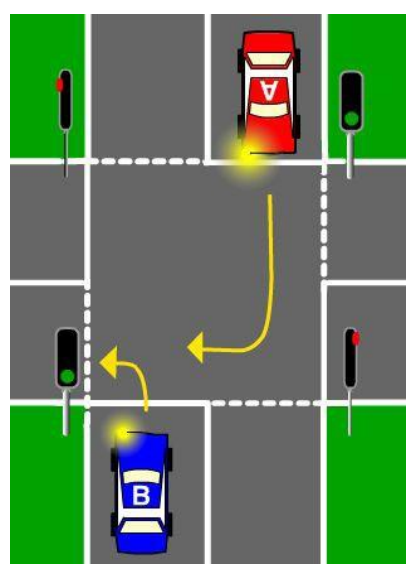
Car A must give way to Car B.
Car B must give way to Car A.
Both must give way to each other.
Neither needs to give way.
A vehicle turning right must give way to oncoming traffic turning left or going straight at an intersection. Since Vehicle B is turning left, Vehicle A must wait for it to pass.
At a GIVE WAY sign at a T-intersection, which traffic must you give way to?
Only vehicles from the right.
Only vehicles from the left.
All vehicles on the continuing road.
Only vehicles turning into your street.
At a T-intersection with a GIVE WAY sign, you must give way to all traffic on the continuing road regardless of direction or your turning intention.
What does this sign mean?
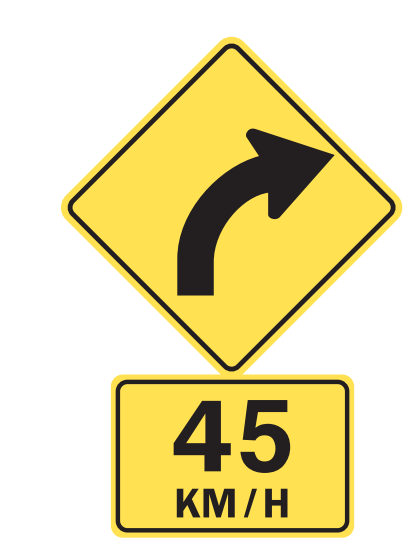
Winding road for 45 km ahead.
45 km/h legal speed limit ahead.
Right turn only for 45 km.
45 km/h advised speed for the curve.
This is an advisory speed sign, which suggests a safe speed for the upcoming curve under good conditions, but it is not a legally enforceable speed limit like a red circle sign.
If driving in heavy rain or fog, you should:
Drive at the posted speed limit.
Use hazard lights and maintain speed.
Slow down and use low beam headlights.
Follow the vehicle ahead closely.
In low visibility, you must slow down and use low-beam headlights. High beams should be avoided as they reflect off the fog or rain and can blind you.
A car behind you is using high beams at night. You should:
Brake hard to slow them down.
Switch on your high beams as a signal.
Adjust your mirror to reduce glare.
Turn your lights off briefly.
Adjusting your mirror helps reduce glare safely while maintaining proper control and focus on the road ahead.
At this intersection with a flashing yellow arrow, Car A must give way to:
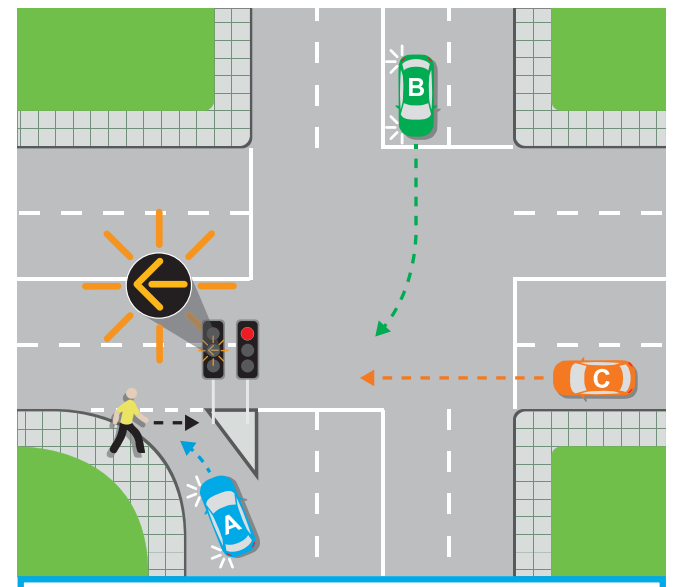
Pedestrian only.
Car B only.
Car C only.
Pedestrian, Car B and Car C.
With a flashing yellow arrow, you must give way to pedestrians and all traffic on the road you are entering before turning.
What does this sign signify?
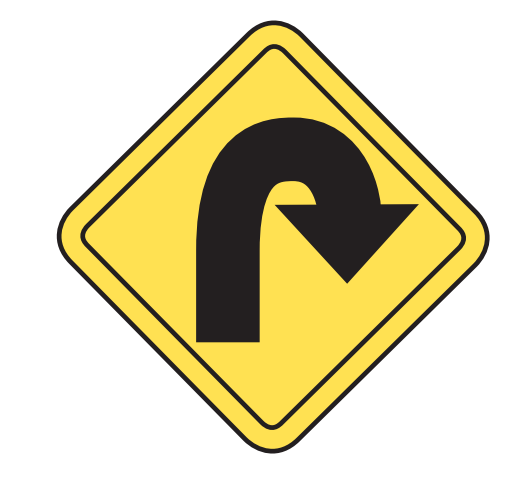
Hairpin bend to the right.
Sharp right turn ahead.
Right turn only.
U-turn permitted ahead.
This warning sign indicates a very sharp, almost reversing curve to the right, requiring significant speed reduction and careful control.
On an unmarked road where lanes merge, who must give way?
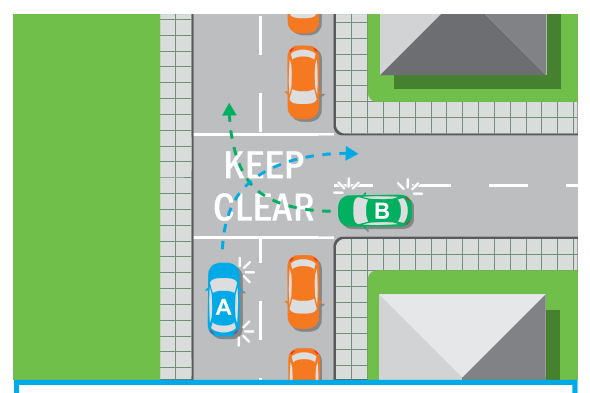
Car B.
Car A.
Both cars.
Neither car.
When lanes merge on an unmarked road, the driver behind must give way to the vehicle ahead.
When braking in an emergency on a motorcycle (dry road), you should use:
Only the rear brake.
Only the front brake.
Both front and rear brakes together.
Downshift without braking.
Using both brakes together provides maximum controlled stopping power on a motorcycle, especially in emergency situations.
Are you allowed to stop or park along a yellow line at the side of a road?
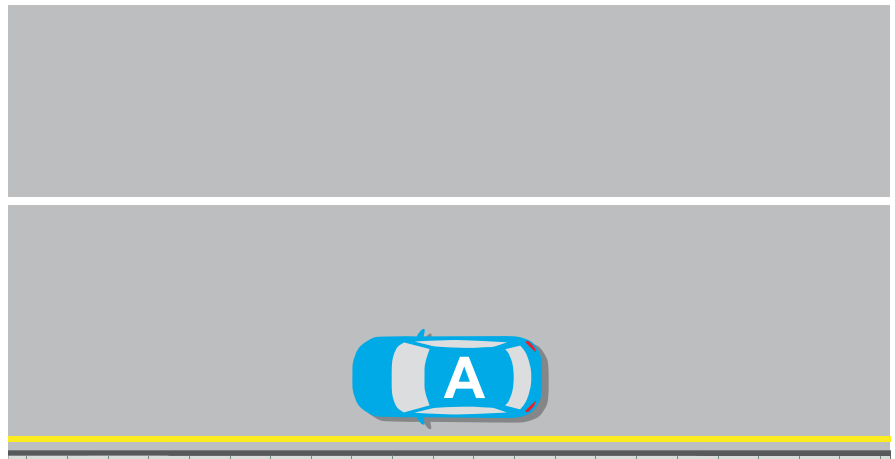
Yes, if traffic is clear.
Yes, for a short time only.
No, stopping or parking is not allowed.
Only if hazard lights are on.
A yellow line along the road edge indicates that stopping and parking are prohibited at all times.
What does this sign represent?
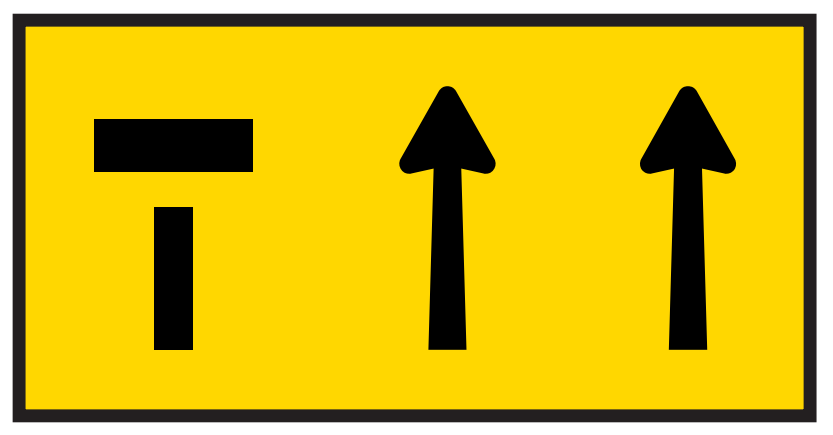
Only left lane open, others closed.
All lanes closed ahead.
Road narrows to one lane.
Left lane closed, two right lanes open.
This lane designation sign shows the left lane is not available while the two right lanes remain open for traffic to continue.
When riding a motorcycle, how should your feet be positioned?
Resting firmly on the footpegs.
Hanging down near the ground.
Resting on the engine guards.
Kept over the brake pedal at all times.
Keeping feet on the footpegs ensures proper control, balance, and quick access to controls while riding.