Syllabus: ACT Road Rules Handbook (2026)
ACT Knowledge Test: Practice Test A
Complete practice set for the Access Canberra Road Rules Test.
Part 1: Mandatory Questions
4 Practice Questions
Part 2: Road Rules
31 Practice Questions
Question Format
Multiple Choice (35 Total)
⚠️ Practice Mode: This is a relaxed study session. You can complete all 35 questions to review the correct answers, even if you make a mistake.
Start Practice Test A
Ready to master the questions?
If you have used illegal drugs you:
Should drink coffee before driving.
Should allow one hour before driving.
Must not drive.
It is illegal and highly dangerous to drive with any presence of illicit drugs in your system as they severely impair your coordination and judgment.
After drinking alcohol you may:
Be able to pay close attention to details in the traffic.
Be able to drive the same as you normally can.
Misjudge speed (your own and others).
Alcohol slows your brain functions and impairs your ability to accurately judge distances and the speed of vehicles.
About how long does it take the body to get rid of the alcohol from one standard drink?

About 30 minutes.
About an hour.
About 2 hours.
The human liver processes alcohol at a steady rate of approximately one standard drink per hour, and this process cannot be speeded up by coffee, food, or sleep.
If there are no speed signs, you must NOT exceed 50 km/h when you see:
Four or more houses along the road.
Street lights and/or buildings along the road.
A Police vehicle.
The presence of street lights or buildings indicates a built-up area where the default speed limit of 50 km/h applies.
What does this sign mean?
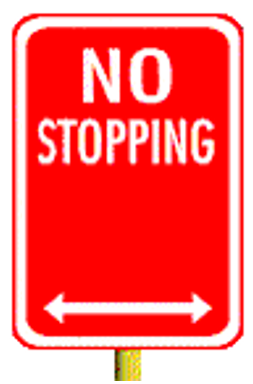
Vehicles are not allowed to stop between these signs.
Vehicles must not stop at the kerb, except if picking up a passenger.
Vehicles must not stop at the kerb, unless picking up goods.
A 'No Stopping' sign means you cannot stop your vehicle for any reason (including dropping off or picking up passengers) in the direction of the arrows.
Using a hand held mobile phone while driving is:
Allowed if you drive slowly.
Not permitted at any time.
Only allowed while waiting at an intersection.
Using a hand-held mobile phone while driving, including when stopped at traffic lights or in congestion, is illegal as it significantly increases driver distraction and the risk of accidents.
Under the points system you may lose your licence (not provisional) if you reach a total of -
4 points in one year.
12 points in three years.
10 points in two years.
For full unrestricted licence holders in the ACT and most Australian states, reaching a threshold of 12 demerit points within a three-year period will result in a licence suspension.
A passenger under 6 months of age must travel:
In the front seat with a parent.
In the front seat using a seat belt.
In an approved properly fastened and adjusted child restraint (eg baby capsule).
Infants under 6 months must be secured in a rear-facing approved child restraint to protect their developing neck and spine during travel.
There is a slow-moving motorcyclist ahead of you. You are not sure what the rider intends to do. What should you do?
Stay behind.
Move closer.
Cross a double unbroken line to overtake the motorcyclist.
If you are uncertain of another road user's intentions, the safest action is to keep a safe following distance and stay behind until their actions are clear.
If turning right at a T-intersection (as shown) must you give way to vehicles approaching from both the left and right?
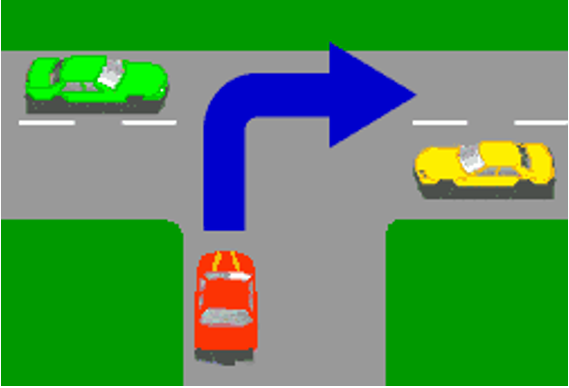
No, only the vehicle on the right.
No, you have right of way.
Yes, whether they are turning or not.
When you are at the terminating road of a T-intersection, you must give way to all vehicles traveling along the continuing road before you turn.
When these lights are flashing it means -
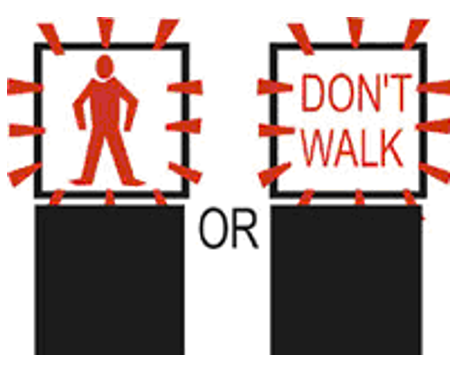
Pedestrians are not allowed in this area at this time.
Pedestrians must not start to cross.
Pedestrians who have started crossing must go back to the footpath.
A flashing red pedestrian signal means you should not begin crossing the road, but if you are already on the crossing, you should finish crossing safely.
What does this sign mean?
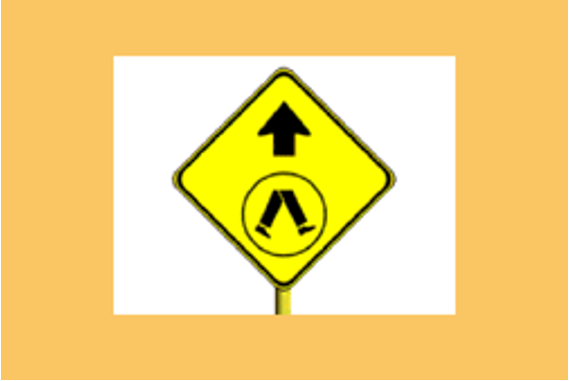
Pedestrian crossing ahead. Slow down and be prepared to stop.
Overhead footbridge for pedestrians ahead.
Joggers ahead. Drive carefully.
This warning sign indicates that a marked pedestrian crossing is approaching, requiring drivers to reduce speed and be ready to yield to anyone crossing the road.
You are turning off a 60 km/h street into a surburban street that has no speed signs. What is the maximum speed limit ?
60 km/h.
50 km/h.
40 km/h.
The default speed limit in built-up suburban areas where no signs are posted is 50 km/h.
If the red lights on this sign are flashing what are you required to do?
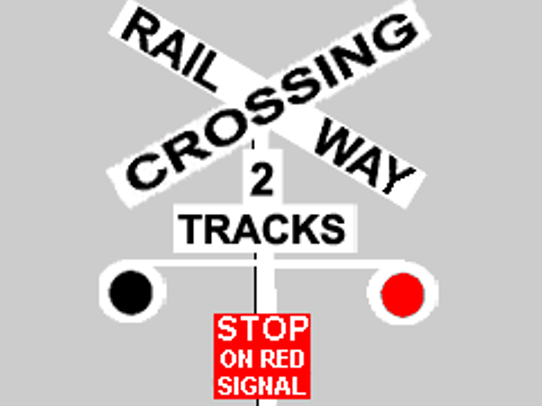
Stop until the red lights stop flashing then drive on if it is safe to do so.
Slow down and drive carefully over the crossing if you cannot see a train approaching.
Stop until the train has passed then proceed immediately.
At a railway crossing, flashing red lights mean a train is approaching, and you must remain stationary until the lights stop flashing and the way is clear.
Having a radar detector or jammer in your car is against the law:
If you purchased it after 1998.
Only if it is turned on.
No matter what your reason is.
It is illegal to possess or use a radar detector or jammer in a vehicle under any circumstances as they are designed to bypass speed enforcement.
What does this sign mean?
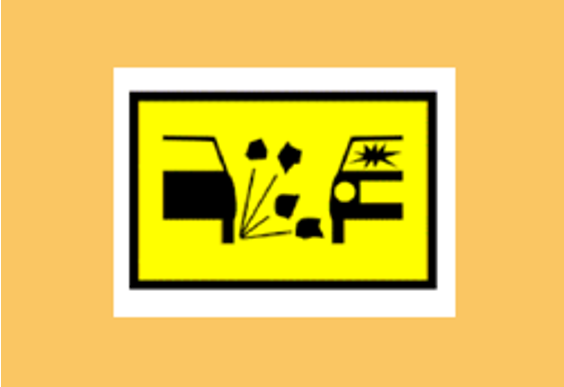
Loose stones on the road ahead. Slow down to avoid windscreen damage.
Check your tyre pressure to avoid a blowout.
Do not pass vehicles coming in the opposite direction.
This sign warns of loose road surfaces where flying stones can be kicked up by tires, so reducing speed helps prevent damage to your vehicle's windscreen and paintwork.
You are in the right hand lane and are planning to go straight ahead through this roundabout. When should you signal left to exit the roundabout?
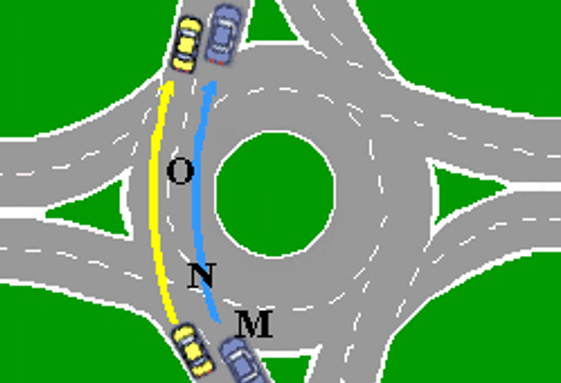
After point N.
After point O.
After point M.
You must signal left only after you have passed the last exit before the one you intend to take to avoid confusing other drivers.
If you are affected by a legal drug, such as a medicine (e.g. cold or allergy tablets):
You must have a passenger to help you drive.
You must not drive.
You may drive only in daylight hours.
It is illegal to drive if any medication impairs your driving ability or makes you drowsy.
You should expect this sign, when:
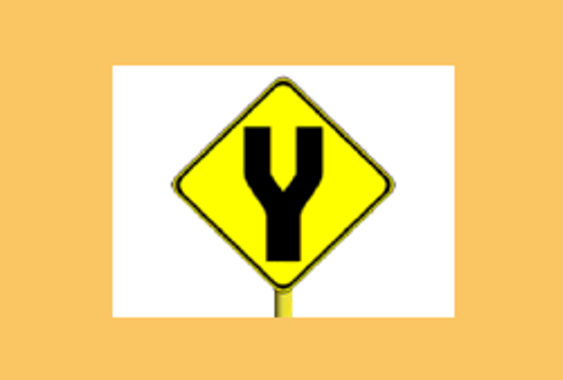
A divided road is ahead. Prepare for a change in traffic conditions.
A two lane bridge is ahead. Slow down and drive carefully.
Freeway conditions are ahead. Maximum speed is 100 km/h.
This sign, showing a road split by a central island, warns that you will soon be driving on a divided road where traffic is separated by a median or barrier.
Do bicycle riders have the same rights and responsibilities while using the roads as drivers and motorcyclists?
Yes.
No, they must always ride on the footpath.
No, they must give way to car and motorbikes at all times when riding on the road.
Under the Australian Road Rules, bicycle riders are considered vehicle drivers and must follow the same rules as other road users.
Looking at the diagram, which vehicle must give way?
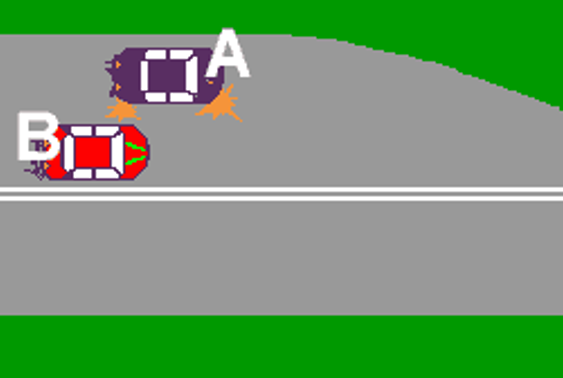
Vehicle A.
Vehicle B.
Either vehicle. There is no rule on giving way when merging.
When changing lanes across a broken line, you must give way to traffic already in that lane.
You want to make a left turn. You must use your left-hand indicator:
Only when there is traffic behind you.
Only when arrows are marked on the roadway.
At all times.
You must always signal your intention to turn to give all road users, including pedestrians and cyclists, sufficient warning of your move.
Are you permitted to park on a median strip or traffic island?
Yes, in daylight hours.
No, not at any time.
Yes, but for no more than 30 minutes.
Parking on a median strip or traffic island is strictly prohibited as it obstructs driver visibility and creates a safety hazard for all road users.
What could be the penalties for driving over the speed limit?
A letter of warning and a small fine.
Fines only.
Fines, demerit points and possibly loss of licence.
Speeding penalties in Australia include monetary fines and demerit points, which can lead to license suspension if the limit is exceeded significantly or repeatedly.
You are on a road with double unbroken centre lines. There are no side streets and no entrances to properties. Are you allowed to cross the centre lines?
Yes, to overtake another vehicle.
Yes, to overtake a pedal cyclist.
No, not under any circumstances.
Drivers in the ACT can cross double unbroken lines to overtake a cyclist if it is safe and they have a clear view of approaching traffic.
When driving in traffic lanes (as shown in the diagram), you may change your lane:
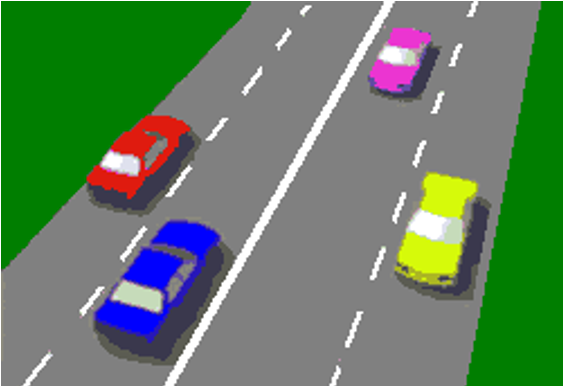
Without looking, provided you use your indicator.
Provided you sound your horn to warn other drivers.
Only when it is safe to do so.
You must only change lanes when there is a sufficient gap and it does not force other drivers to suddenly change speed or direction.
If you hold a learner or provisional licence class what is the Blood Alcohol Concentration (BAC) limit?
Zero.
0.02.
0.05.
Drivers holding a learner or provisional licence must maintain a zero blood alcohol level at all times while driving to ensure maximum alertness and safety.
Which vehicle is making a legal 'U' turn?
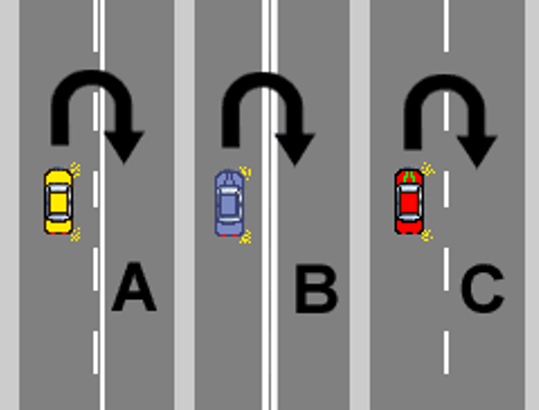
A.
B.
A & C.
You can make a U-turn across a single broken line or a single continuous line, but never across double continuous lines.
This sign means:
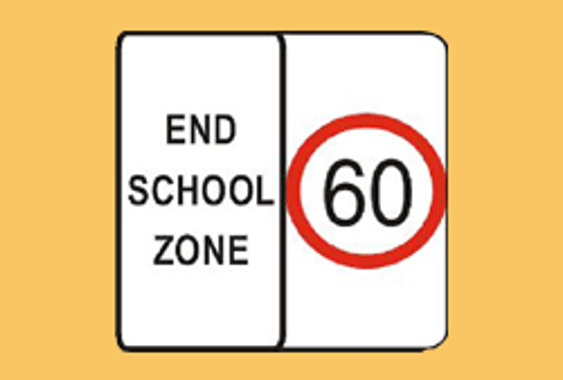
You are leaving a school zone, the speed limit is now 60 km/h.
End of school zone, the speed limit is now 100 km/h.
End of 60 km/h zone.
This sign marks the end of a school zone and indicates the new speed limit is 60 km/h.
Which movements shown in the diagram can legally be made by the driver of the car marked "A"?
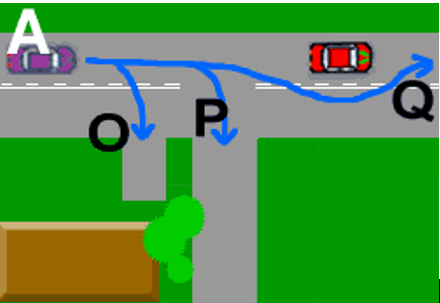
O and P only.
P only.
O, P and Q.
In the ACT, a driver can cross a single broken line (like the one shown in the image) to enter or leave the road (movements O and P) or to overtake another vehicle (movement Q), provided it is safe to do so.
In the ACT, the speed limit in school zones is 40km/h. When does this speed limit generally apply?
8am to 4pm on school days.
8:00am to 9:30am and 2:30pm to 4:00pm on school days.
24 hours a day, seven days a week.
In the ACT, school zone speed limits are in effect continuously from 8:00 am to 4:00 pm on school days.
If you come across potholes as you drive along, you should steer gently around them –
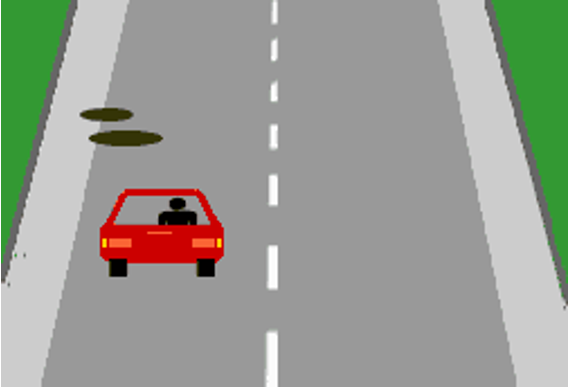
At all times.
Only if they are very big.
If it is safe to do so.
You should only steer around potholes when you have clearly checked your surroundings and confirmed that the maneuver won't endanger other vehicles or cyclists.
Child restraints (eg, baby capsules and child seats):
Are not as safe as holding a child in your arms.
Need only be used if the child wants to sleep.
Should be fitted according to the manufacturers' instructions.
For a child restraint to provide maximum protection during a crash, it must be installed and used exactly as specified by the manufacturer.
What should you do when you see this sign?
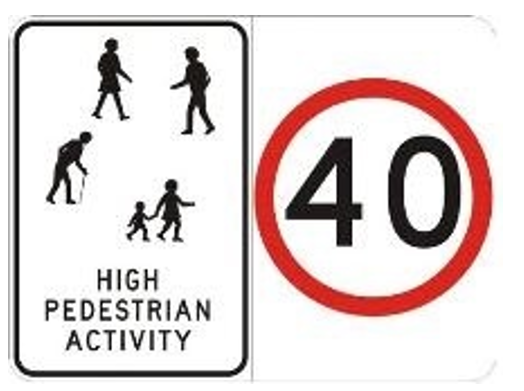
Be aware that vulnerable road users use this zone and anticipate their presence.
Slow down to 40km/h when you see a pedestrian in this zone.
Drive no faster than 40km/h and anticipate the presence of a pedestrian by scanning for their presence.
This sign indicates a high pedestrian activity area where a mandatory 40km/h speed limit applies to protect people on foot.
In this roundabout with two lanes, can the marked car turn right?
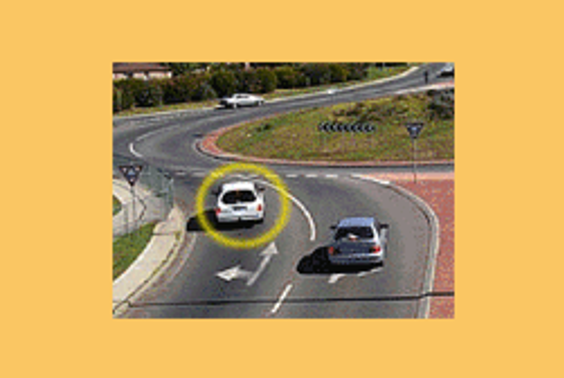
Yes, after changing to the right hand lane.
Yes, at any time.
No, not at any time.
The marked car is in a lane with a "straight or left" arrow marking, which strictly prohibits making a right-hand turn from that position.