Syllabus: NT Road Users’ Handbook (2026)
NT Theory: Full Practice Test C
Complete practice set for the Northern Territory Learner’s Theory Test.
Part 1: General Knowledge
20 Practice Questions
Part 2: Road Rules
10 Practice Questions
Question Format
Multiple Choice (30 Total)
⚠️ Practice Mode: This is a relaxed study session. You can complete all 30 questions to review the correct answers, even if you make a mistake.
Start Practice Test C
Ready to master the questions?
You drive towards these people on the road. What should you do?
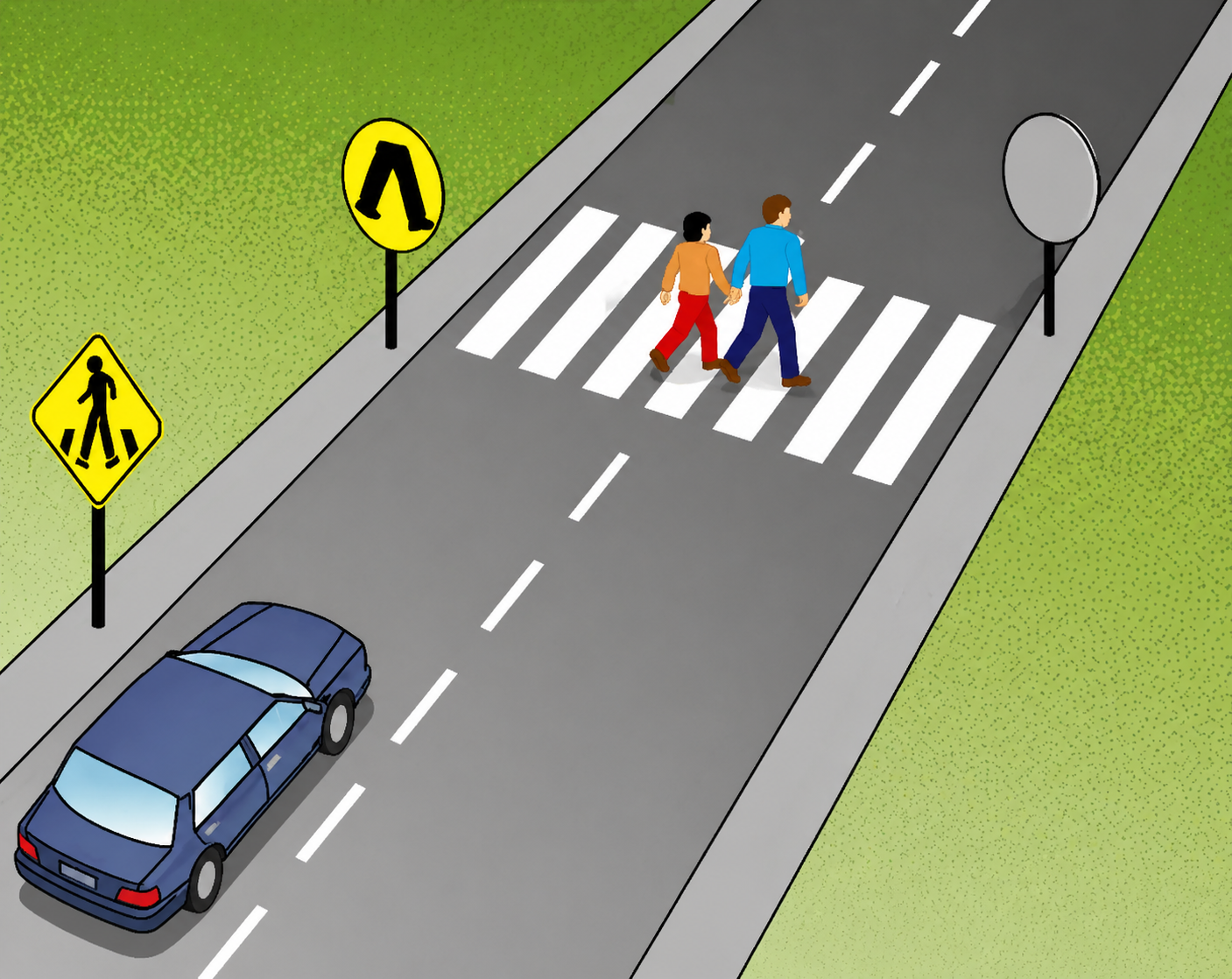
Slow down until they are half way through the crossing and drive on.
Stop and give way if there is any danger of hitting them.
Continue at the same speed and sound the horn.
When approaching a pedestrian crossing, you must yield to anyone on the crossing. You should stop completely to ensure their safety until they have safely reached the other side.
In this roundabout with two lanes, can the marked car turn right?
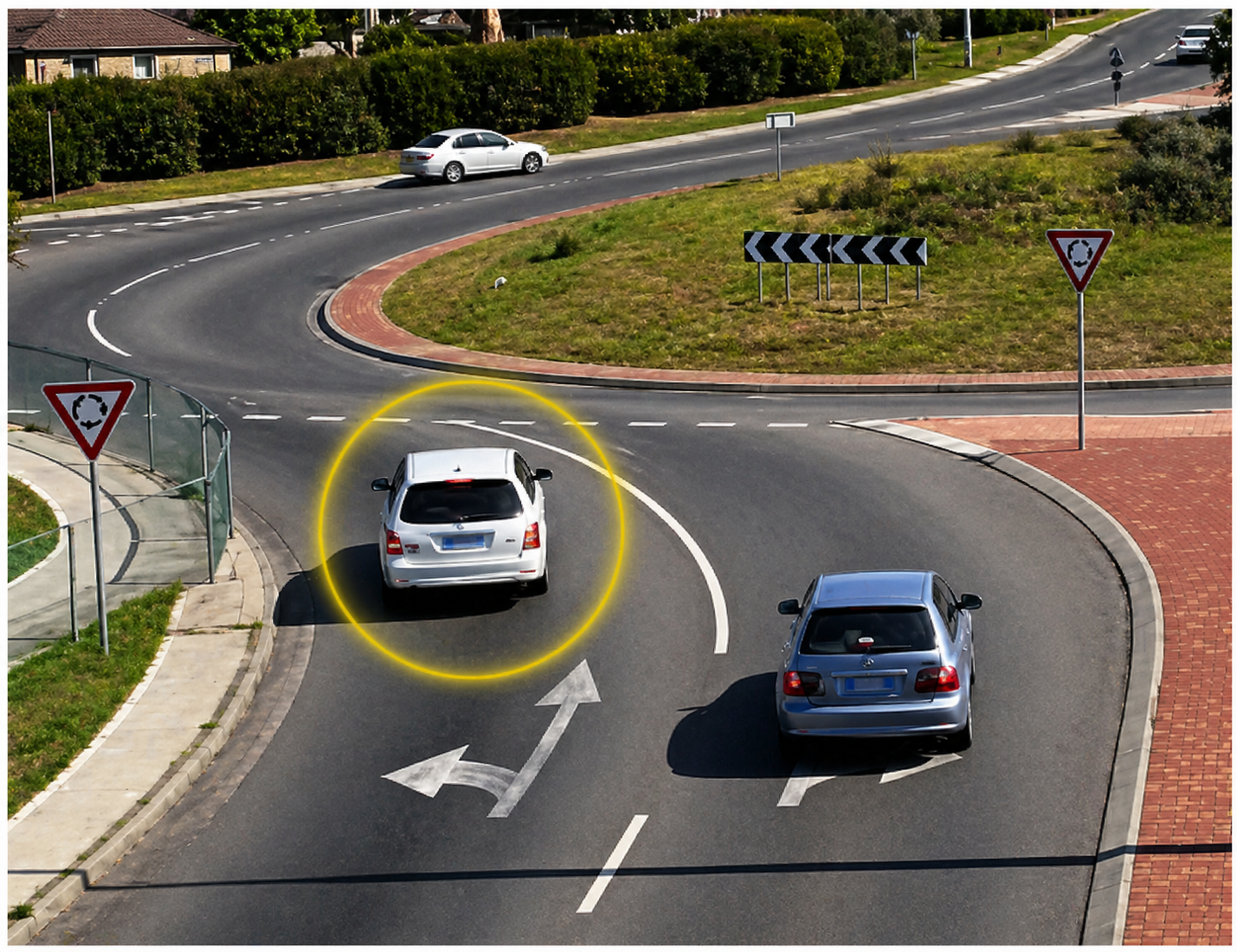
No, not at any time.
Yes, after changing to the right hand lane.
Yes, at any time.
The arrows on the road surface indicate that the left lane is for turning left or going straight only. You cannot turn right from this lane.
Are you permitted to make a U-Turn at traffic lights?
Yes, at all times.
No unless there is a U-TURN Permitted sign at the intersection.
Yes, if there is no danger of colliding with another vehicle.
You cannot perform a U-turn at traffic lights unless a specific sign says you can. This keeps intersections orderly and safe.
If you are affected by a legal drug, such as a medicine (e.g. cold or allergy tablets):
You may drive only in daylight hours.
You must not drive.
You must have a passenger to help you drive.
If a medicine makes you feel drowsy or affects your reactions, it is unsafe and illegal to drive, regardless of whether the drug is legal or prescribed.
Looking at the diagrams, how far from the approach side of a bus stop or a railway crossing are you allowed to stand or park your vehicle?
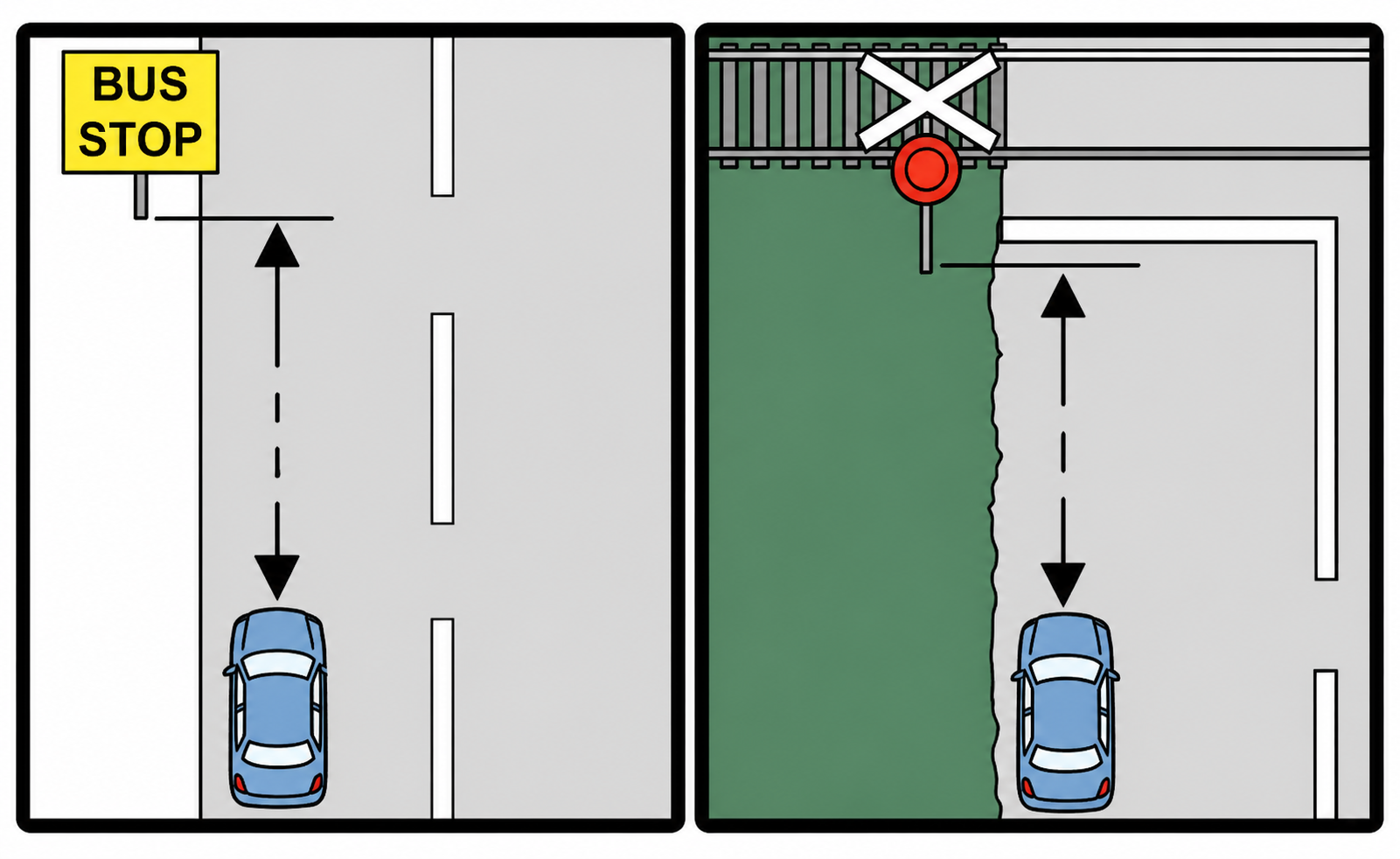
At least 5 metres.
At least 20 metres.
At least 50 metres.
You must not park within 20 metres of the approach side of a bus stop or level crossing to ensure clear visibility for all drivers and public transport operations.
At this intersection there are no signs or traffic lights. You are in the car marked A. You want to turn left. What should you do?
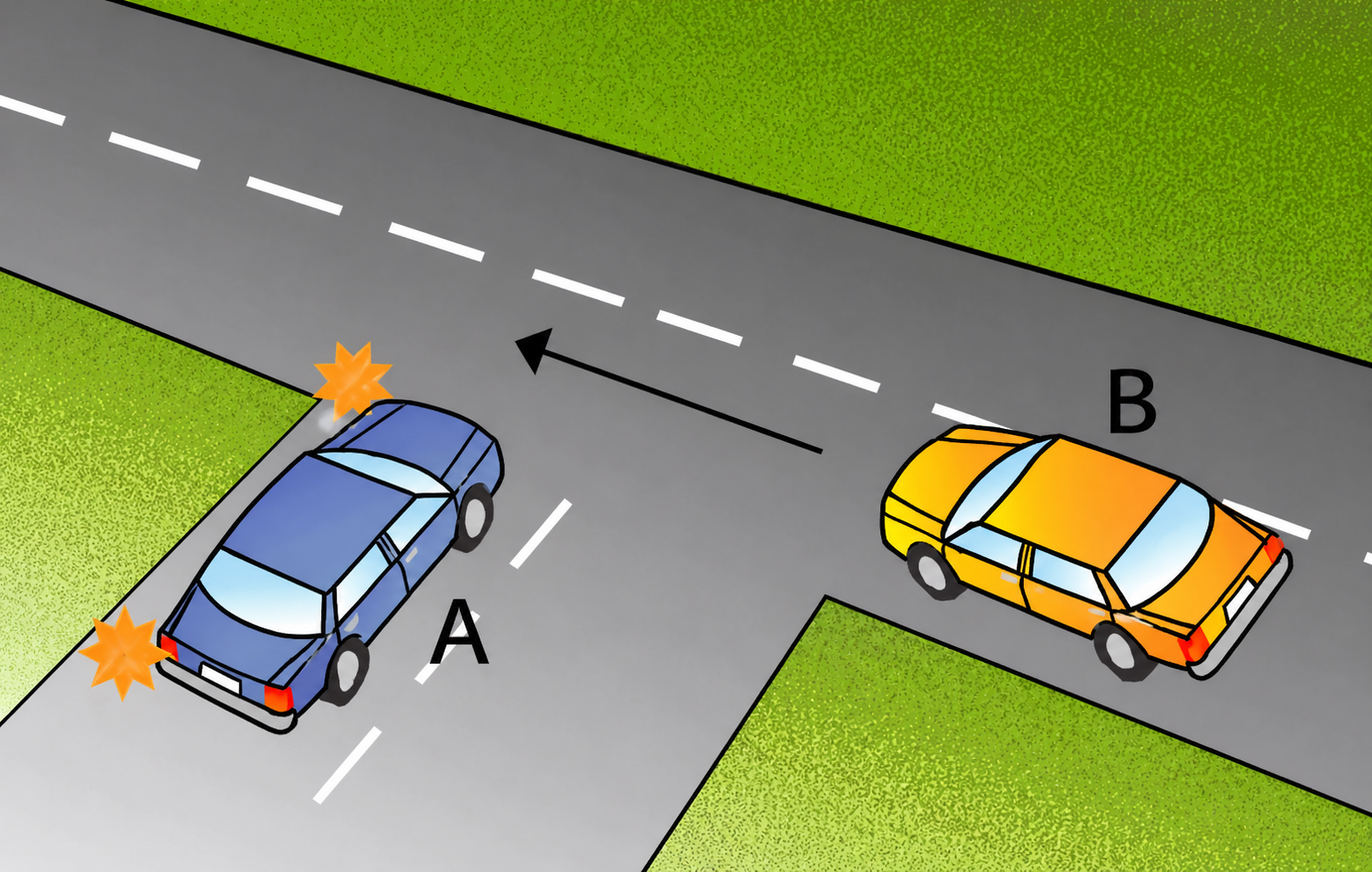
Enter the intersection and make the turn.
Sound the horn to warn the other driver.
Slow down and give way to car B on your right.
At an intersection with no signs or lights, you must give way to any vehicle on your right. Since car B is to your right, you must let it pass before you turn.
If you see a horse and rider on the road what should you do?
Slow down and give them plenty of room.
Sound your horn to warn the rider.
Speed up to pass the horse.
Horses are easily spooked by noise and fast movement. Slow down and provide a wide berth to ensure the safety of the rider and the animal.
Which vehicle in the diagram must give way?
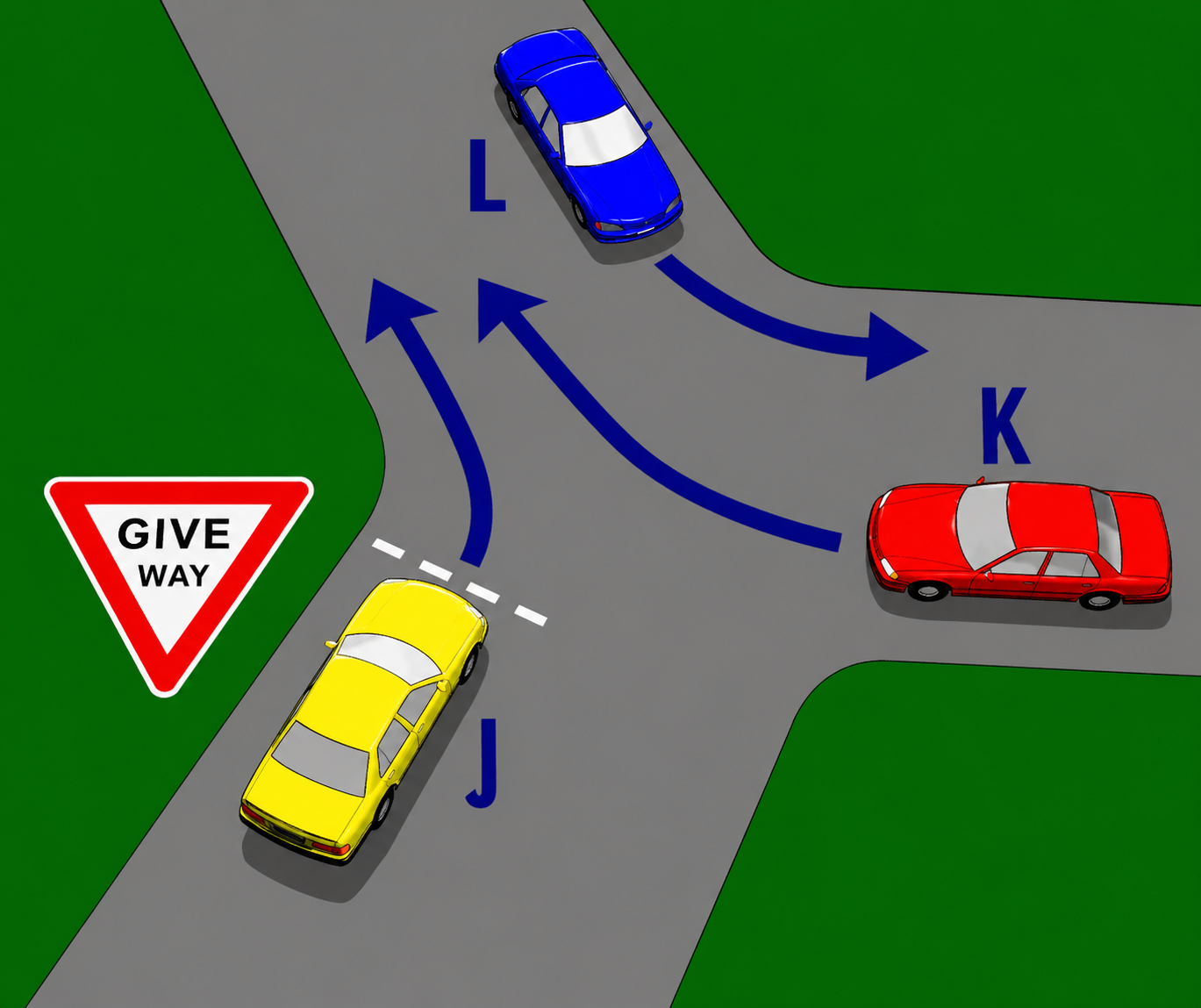
Vehicle K.
Vehicle J.
Vehicle L.
Vehicle J has a GIVE WAY sign. This means J must wait and let both K and L pass before moving, as they are already on the main road.
If elderly people or children are on a pedestrian crossing you will probably need to:
Wait extra time to allow them to cross safely.
Sound your horn to hurry them up.
Drive around them so you don't hold up traffic.
Children and elderly pedestrians often move more slowly or may be less aware of traffic. You must be patient and give them all the time they need to reach the sidewalk safely.
Providing they are not breaking the speed limit, what is the maximum speed for learner drivers?
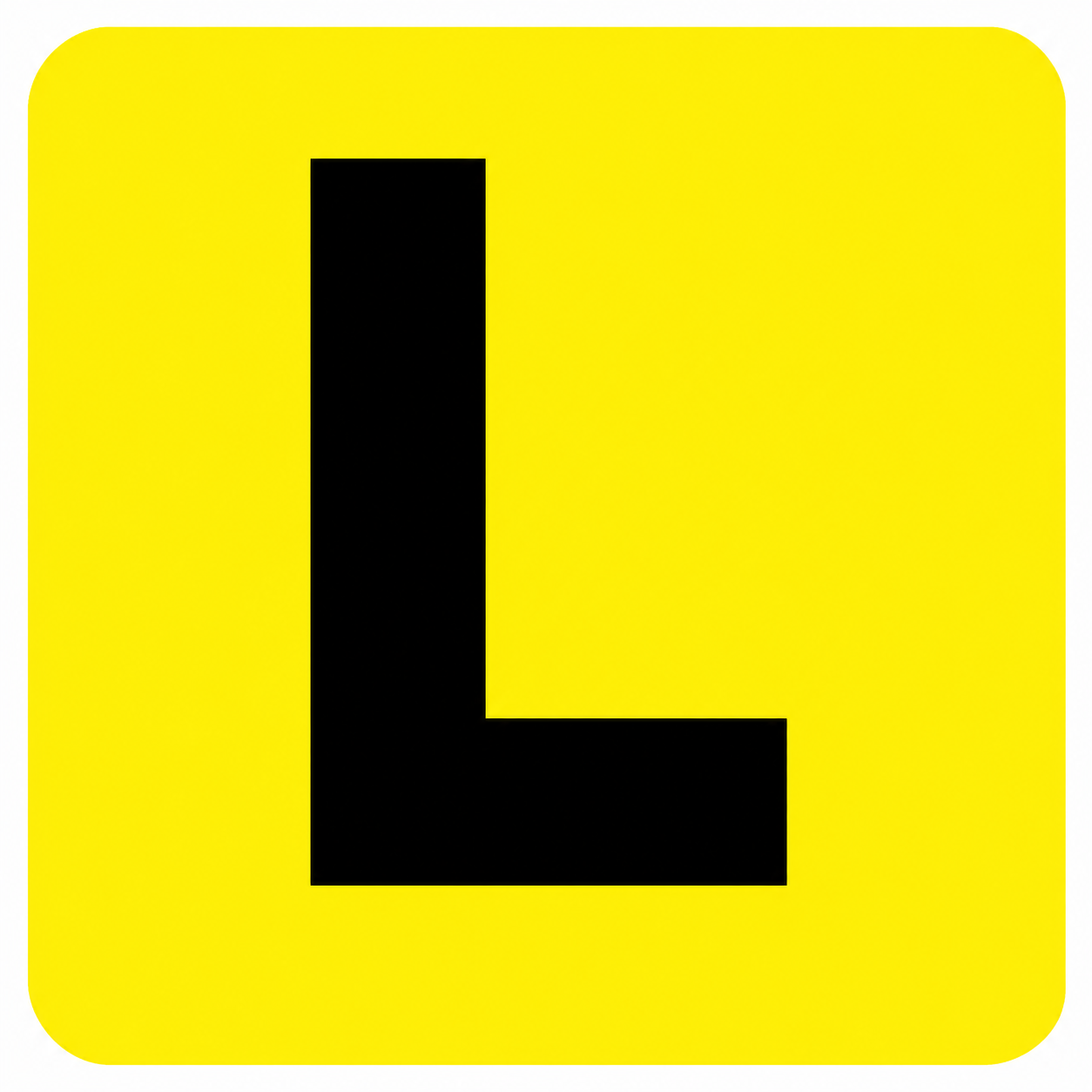
80 km/h.
60 km/h.
100 km/h.
In New South Wales, the absolute maximum speed limit for a learner driver is 80 km/h, even if the posted road sign allows for a higher speed.
Vehicle O is at a STOP sign:
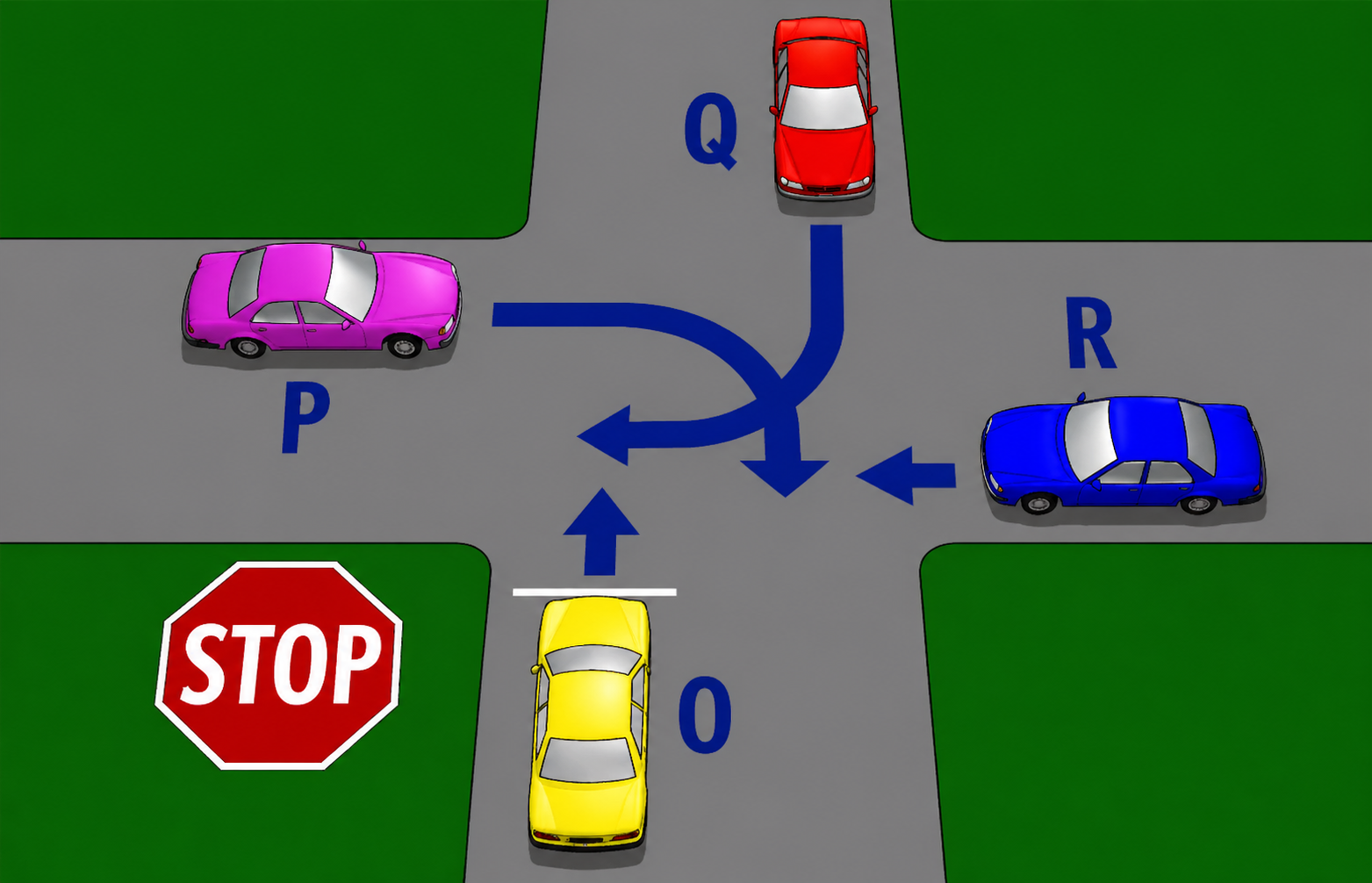
Vehicle O must give way only to vehicle R.
All vehicles must give way to vehicle O.
Vehicle O must give way to vehicles P, Q and R.
A STOP sign requires you to come to a complete halt and give way to all traffic already in, entering, or approaching the intersection from any direction.
What does this sign mean?
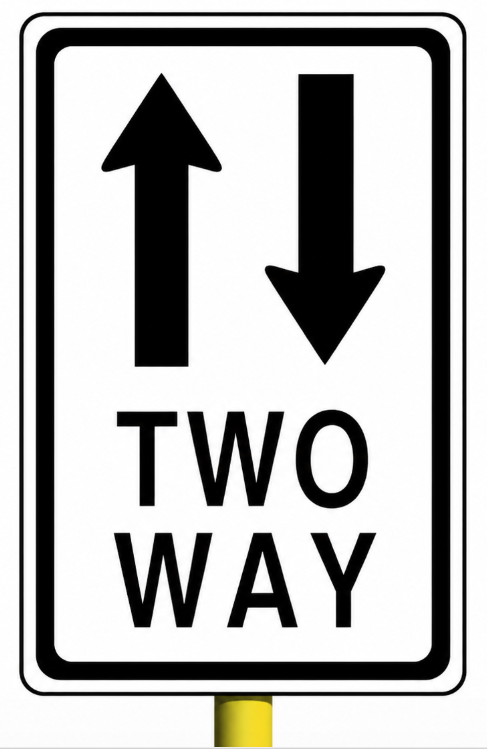
Double lane bridge ahead.
Traffic travels in each direction.
No turns permitted.
This sign warns that the road has two-way traffic, so you must stay in your lane and watch for oncoming vehicles.
Which of the following attitudes is most likely to make you a safer driver?
Crashing or not crashing is a matter of luck.
When I drive, I have the main responsibility for my safety and the safety of other road users.
It is up to other drivers to avoid crashing into me.
Safe driving is about taking personal responsibility. Relying on luck or the actions of others increases risk; you must actively monitor the road and drive defensively to prevent accidents.
Which side mirror is adjusted best?
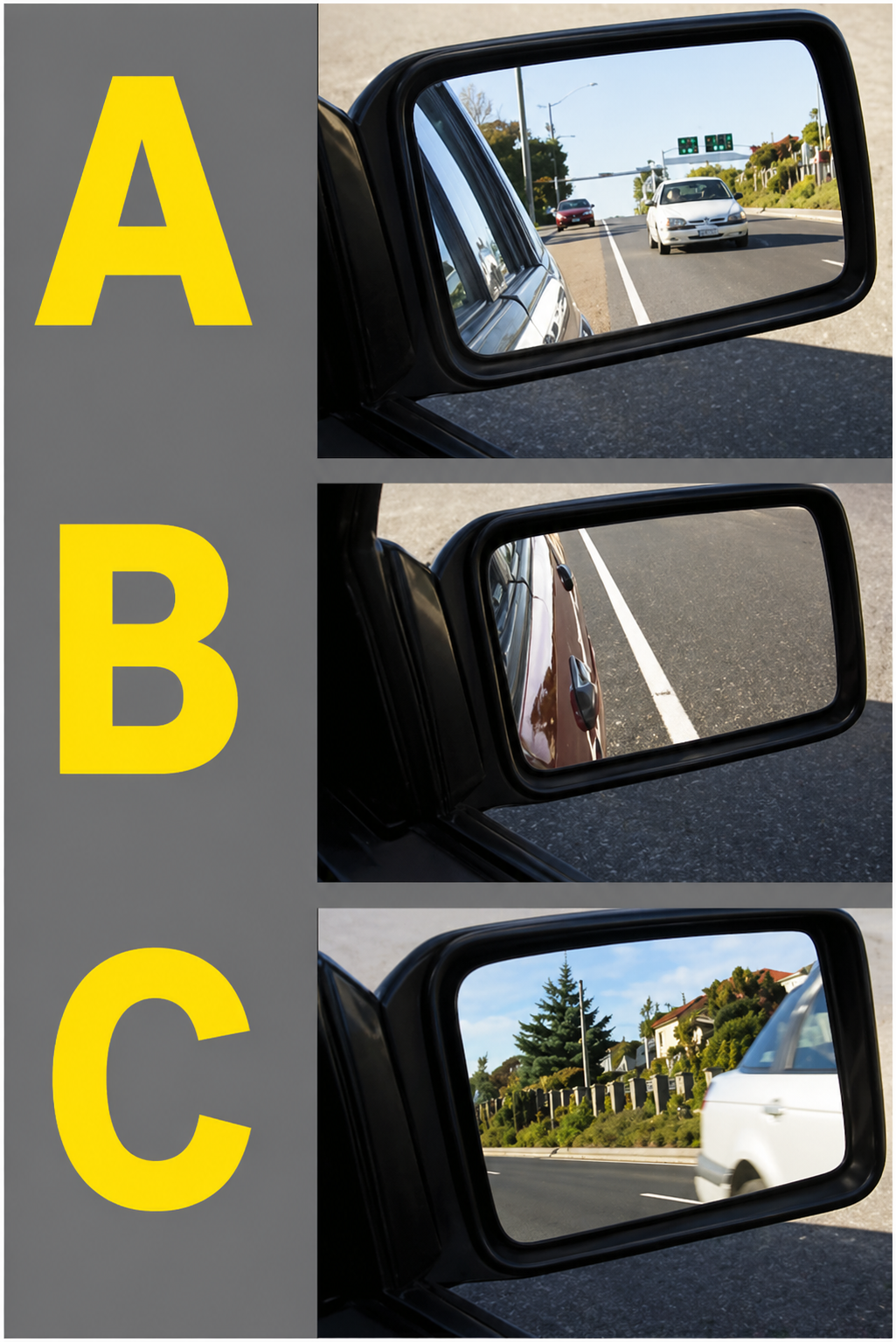
Mirror A.
Mirror B.
Mirror C.
Mirror A is adjusted correctly because it shows a wide view of the road and traffic behind, with only a small part of your own car visible for reference.
If you have used illegal drugs you:
May drive only in light traffic.
Should drink coffee before driving.
Must not drive.
Driving with any presence of illegal drugs in your system is strictly prohibited because they impair your judgment and reaction time.
You are facing traffic lights (as shown). What do they mean?
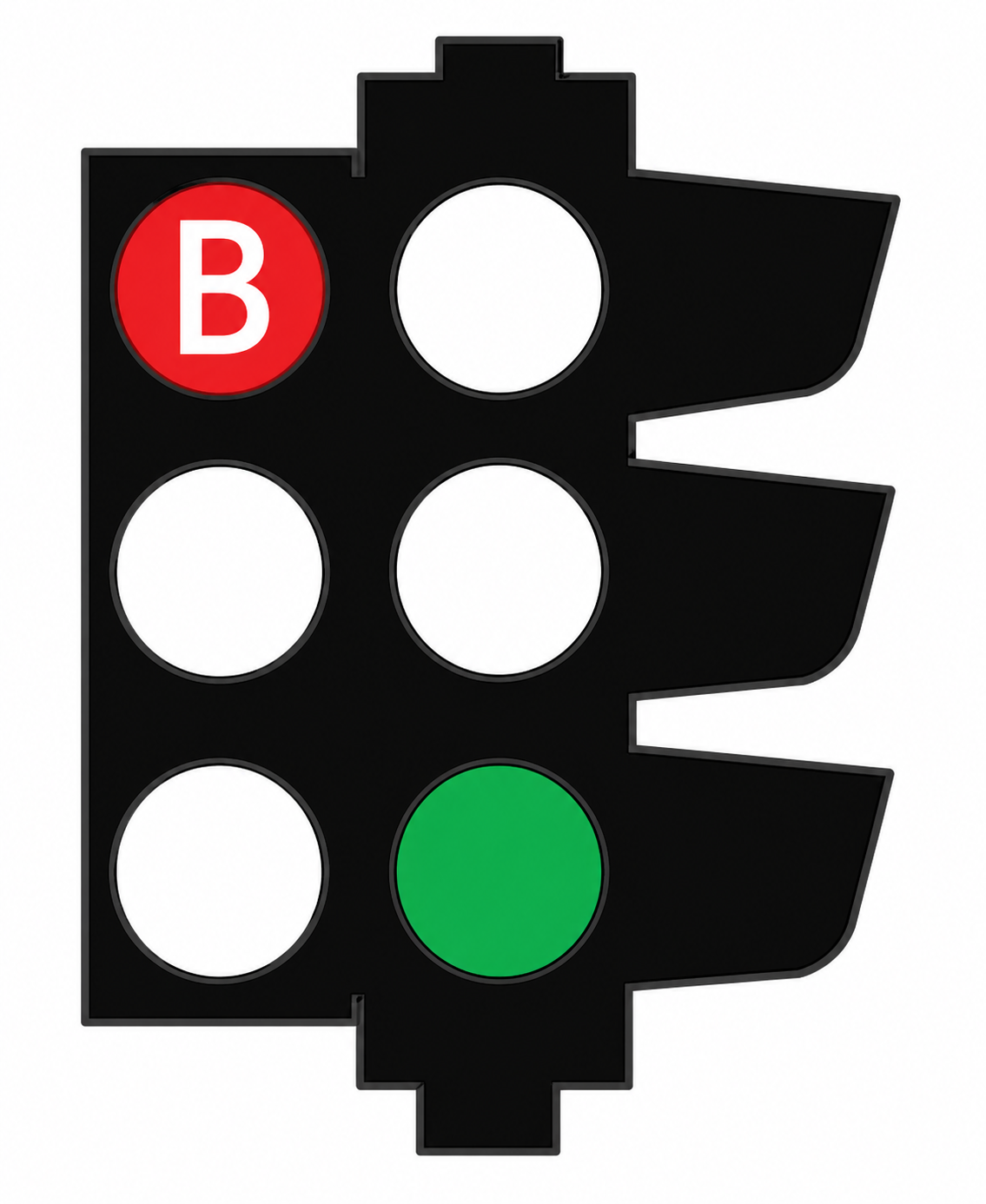
Only buses can proceed through the intersection.
All vehicles can proceed through the intersection.
Buses must stay while all other vehicles proceed through the intersection.
In this diagram, the lights are split. The green circle gives regular traffic the "Go," but the red 'B' is a specific signal for bus drivers, telling them they must remain stopped while others move.
How should you merge with traffic?
Stop, then enter the traffic quickly.
Watch for a gap and merge with the traffic at the speed it is travelling.
Speed up and force your way into the traffic.
Merging works best when you match the speed of the existing traffic flow. This allows you to slide into a safe gap without forcing other drivers to brake suddenly.
The first thing you should do before overtaking is:
Increase your speed.
Sound your horn.
Make sure it is safe and the way is clear of oncoming traffic.
Safety is the top priority. Before pulling out to overtake, you must confirm there is enough room and no oncoming vehicles that could cause a collision.
Having a radar detector in your car is against the law:
Only if it is turned on.
If you purchased it after 1998.
No matter what your reason is.
It is illegal to possess or use a radar detector in a vehicle. Even if the device is turned off or you have a specific reason for having it, you can still be fined and have the device confiscated.
As you drive into an intersection, the lights turn to yellow. You should:
Brake immediately to a stop.
Continue through the intersection.
Accelerate as hard as you can.
If you are already in the intersection, you must clear it safely rather than stopping suddenly.
What does this sign mean?
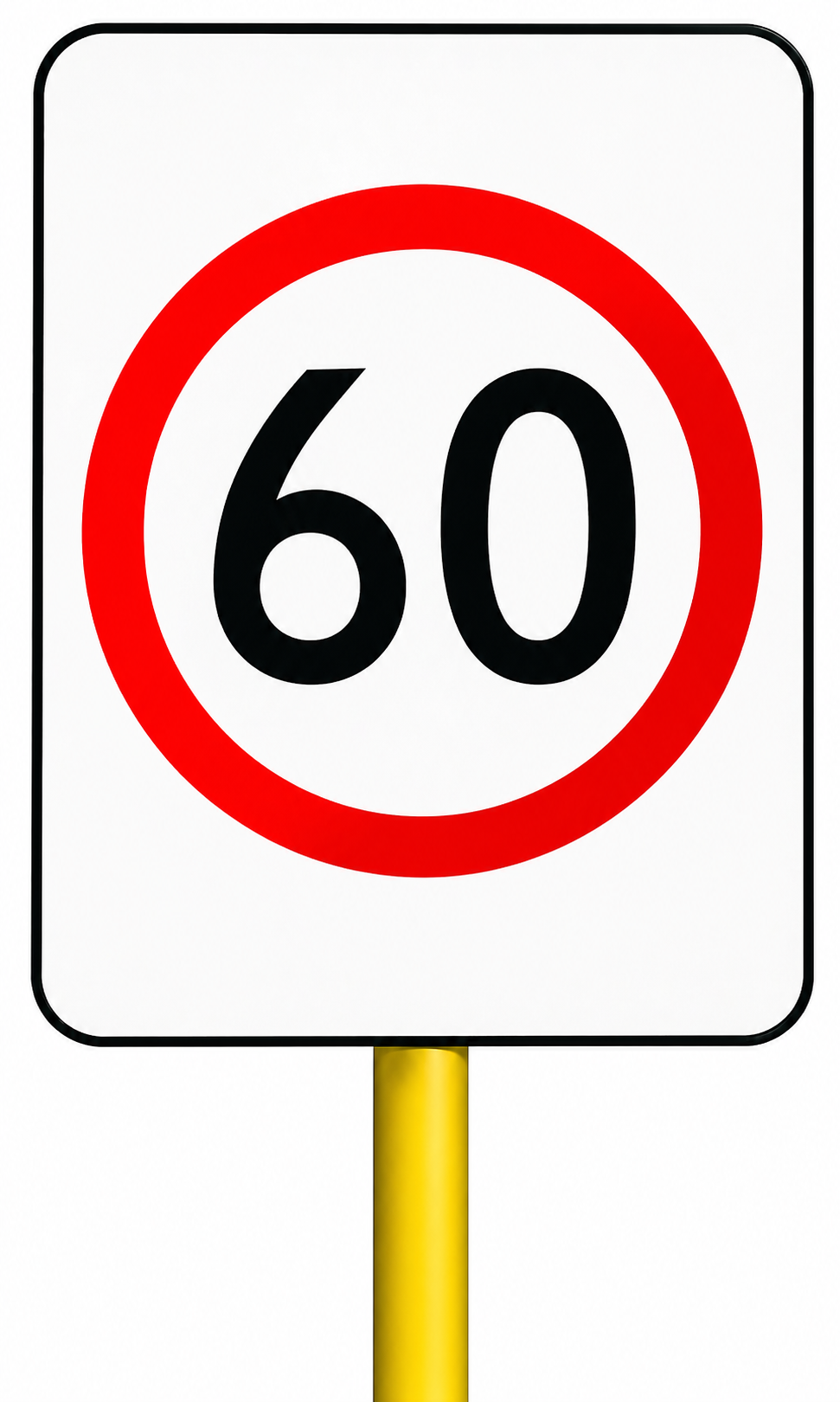
You are not to exceed 60 km/h.
You can go faster than 60 km/h.
You are on Highway 60.
This is a regulatory speed limit sign. The number inside the red circle is the maximum legal speed you are allowed to drive in good conditions.
If there are no lanes marked on the road, you should drive:
Anywhere on your side of the road.
Along the middle of the road.
Near to the left-hand side of the road.
Even without lane markings, you must keep to the left. This ensures there is enough space for oncoming vehicles to pass you safely.
What is this driver doing that is negligent and illegal?
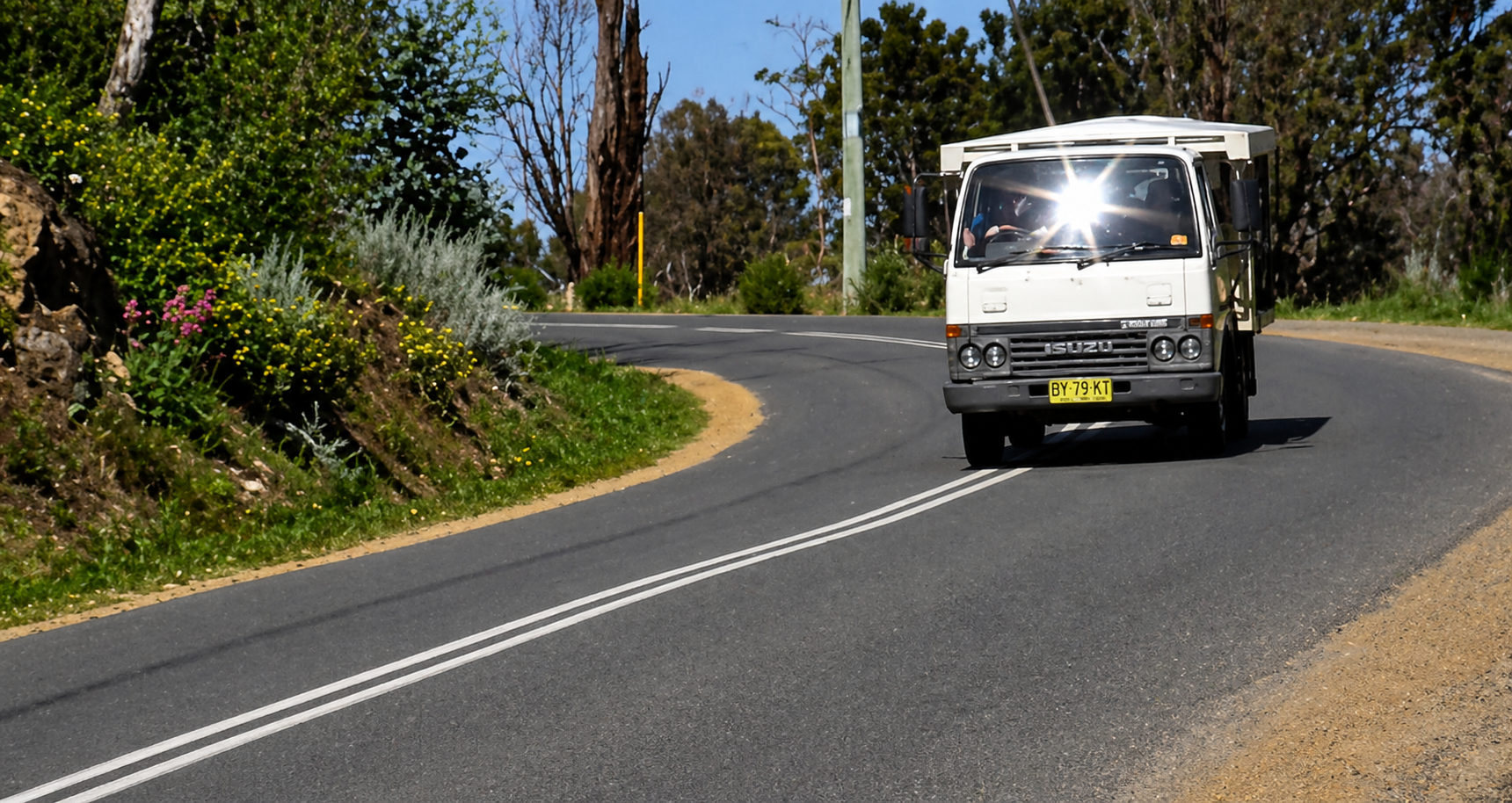
Not signaling to change lanes.
Crossing an unbroken line at a curve.
Overtaking on the kerb side.
The driver is crossing a double solid white line on a bend. This is illegal and dangerous because you cannot see oncoming traffic clearly around the curve.
Seat belts and child restraints (e.g. baby capsules and child seats):
Must always be worn properly, and adjusted tightly.
Are only needed on short trips.
Are only needed on long trips.
Safety restraints are mandatory for every trip, no matter the distance. They must be correctly fitted and tightened to provide maximum protection in the event of a crash.
If you are charged for street racing (hooning), which of these penalties may apply?
You will get three demerit points and a large fine.
You will be given a letter of warning and fined.
You will be fined a small amount and get one demerit point.
Street racing and "hooning" are considered high-risk offenses. Penalties are severe and can include heavy fines, demerit points, and even vehicle impoundment.
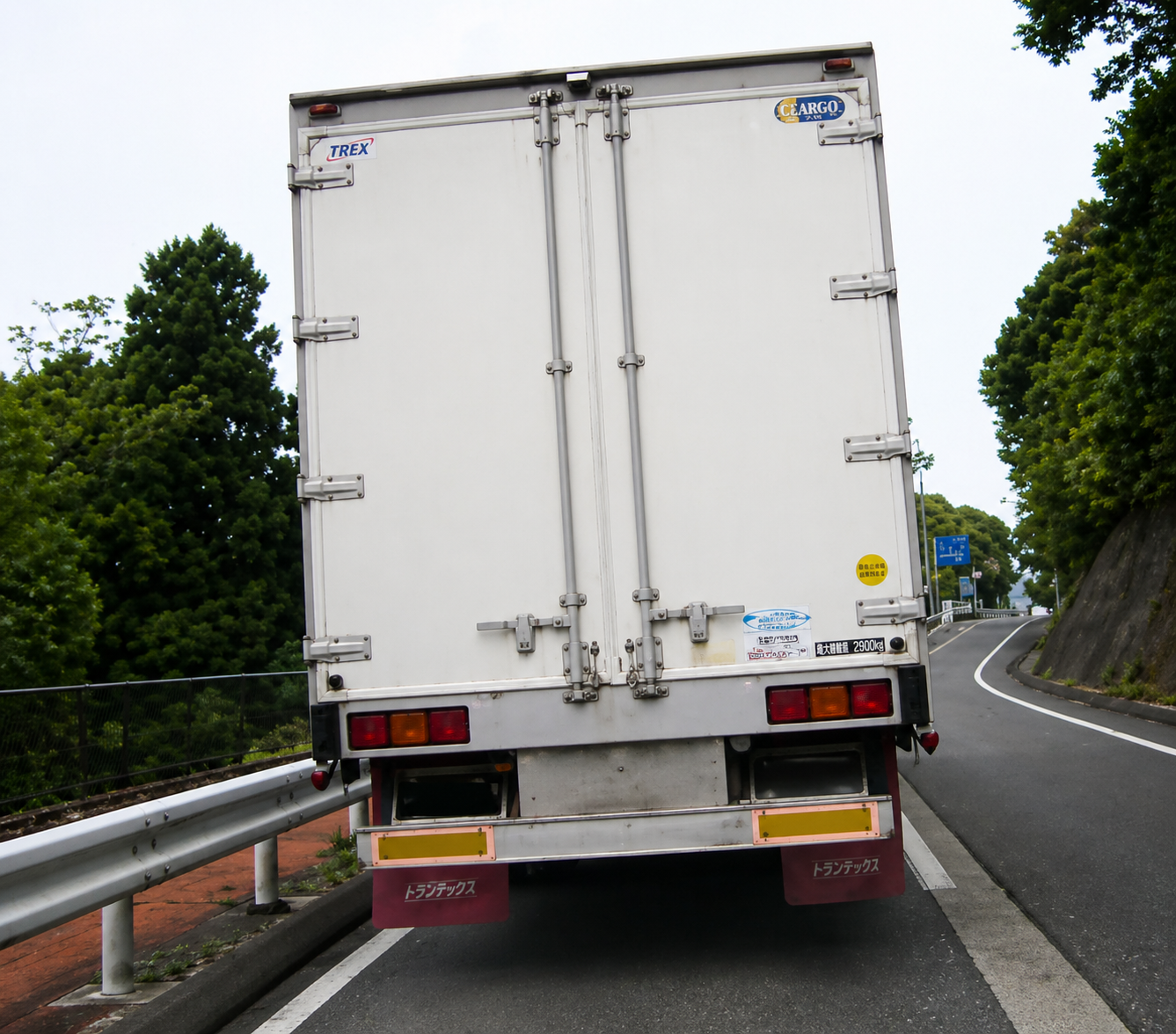
Following this vehicle too closely is unwise because:
Your engine will overheat.
Your brakes will overheat.
Your view ahead is reduced.
Large vehicles like trucks block your line of sight. Following too closely makes it impossible to see road hazards, traffic signals, or oncoming vehicles ahead of the truck.
Is it an offence to refuse to take a POLICE breath test?
No - if you are a learner driver.
Yes - always.
No - if you say you haven't been drinking alcohol.
Refusing a breath test is a crime and carries heavy penalties similar to drink driving.
At night, if an oncoming vehicle’s headlights dazzle you, you should:
Slow down, until your eyes recover.
Close your eyes for a short time until they recover.
Watch the centre line of the road.
If dazzled, slow down or stop to regain clear vision. Looking toward the left edge of the road can also help you stay on track without staring into the lights.
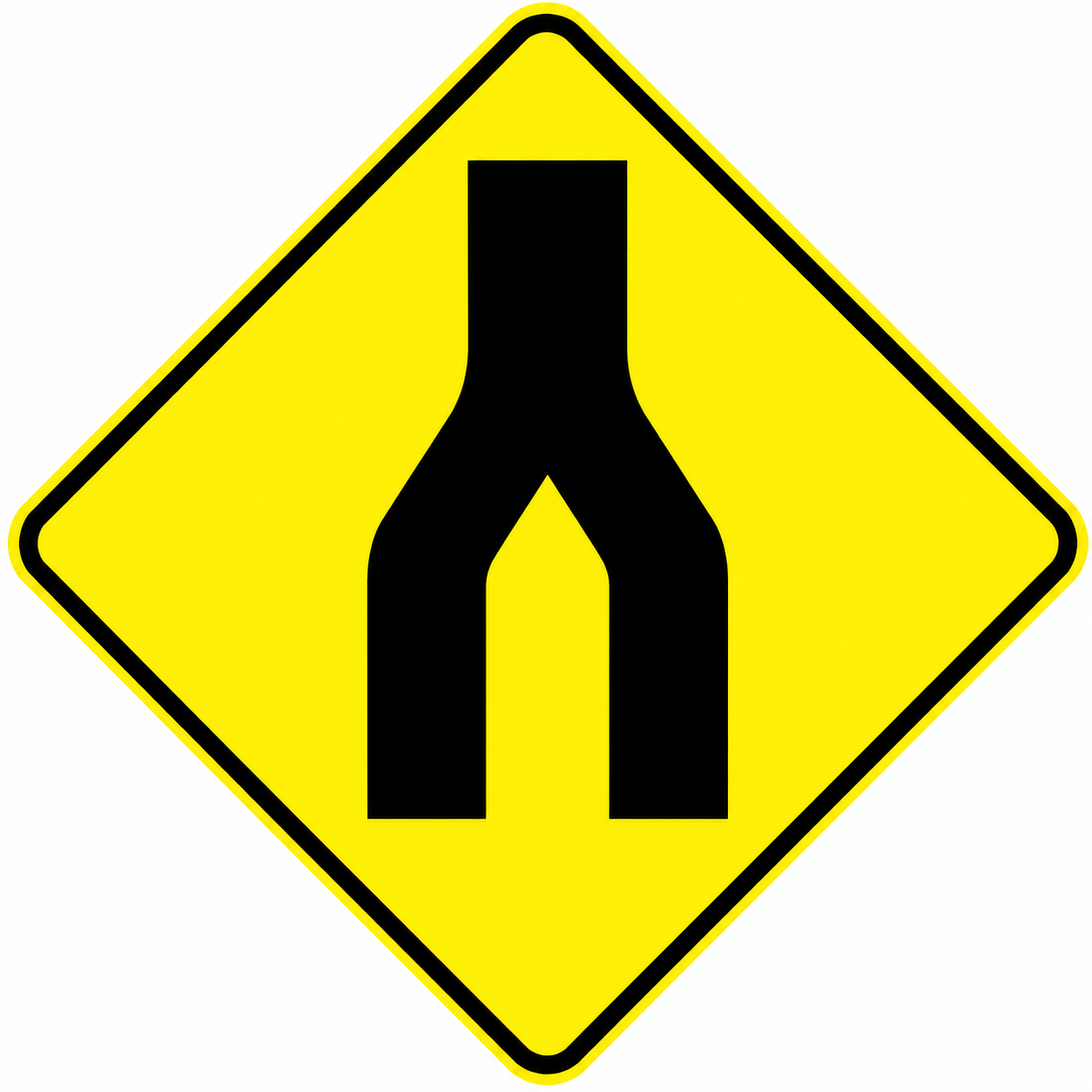
You should expect this sign:
If a one lane bridge is ahead.
If a one way street is ahead.
When a divided road ends and two way traffic is ahead.
This sign warns that the physical barrier (median) separating traffic is ending. You need to prepare for oncoming traffic sharing the same undivided road ahead.
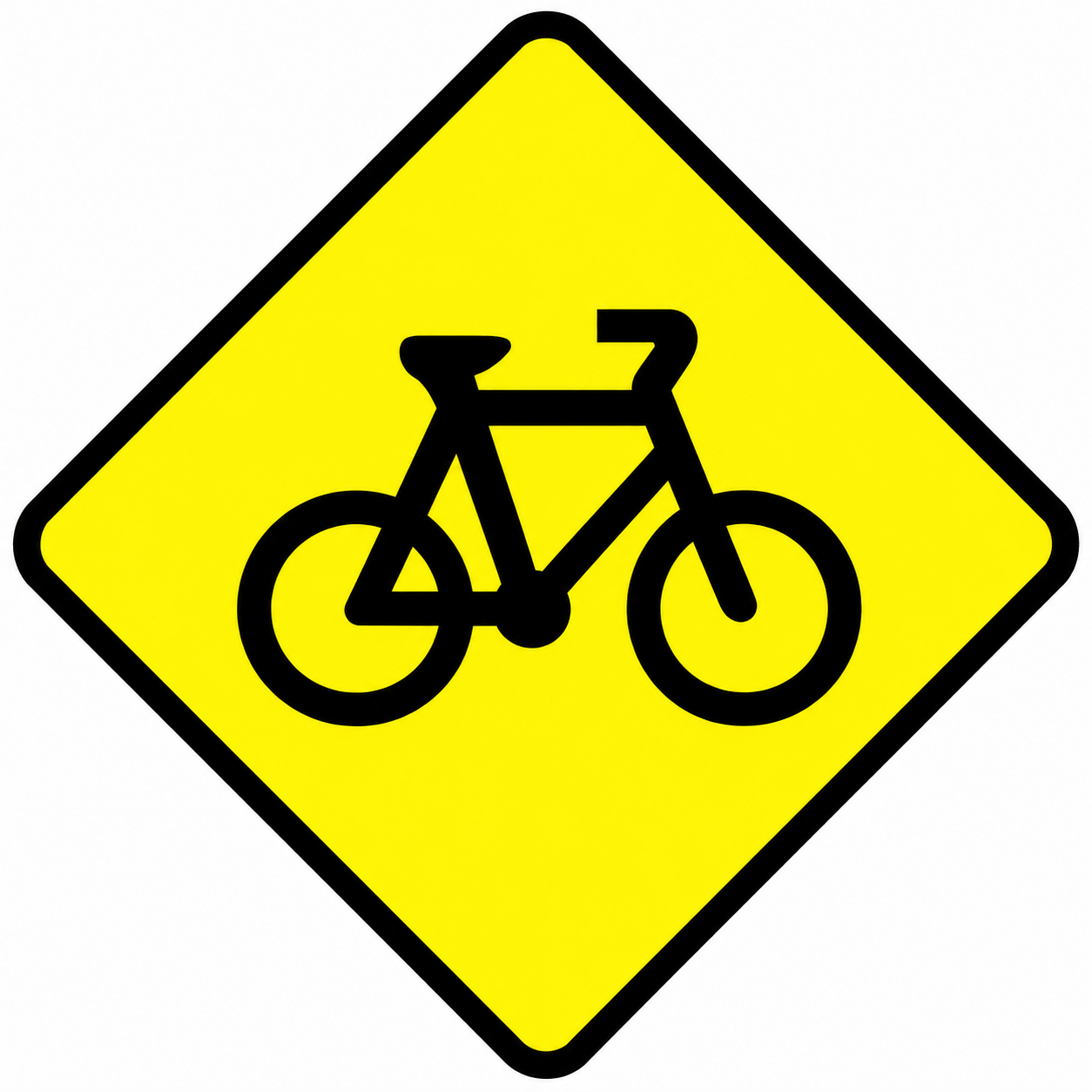
Safety tips when driving near a cyclist, choose the correct answer:
You are approaching a children's playground, slow down.
Bicycle riders are not allowed on the road.
Caution, bicycle riders may be using the road.
This yellow warning sign alerts you that cyclists are likely to be in the area. You should stay alert and give them plenty of room when passing.