Syllabus: SA Driver’s Handbook (2026)
SA Theory: Full Practice Test B
Complete practice set for the Service SA Learner’s Theory Test.
Part 1: Give Way
8 Mandatory Questions
Part 2: Road Rules
42 Practice Questions
Question Format
Multiple Choice (50 Total)
⚠️ Practice Mode: This is a relaxed study session. You can complete all 50 questions to review the correct answers, even if you make a mistake.
Start Practice Test B
Ready to master the questions?
Can you drive with a blood alcohol level over 0.00 if you have a Learner's Permit?
Yes, up to 0.05.
Yes, only at night.
No, it must be exactly zero.
Learner's Permit holders are subject to a strict zero alcohol limit, meaning they cannot have any alcohol in their system while driving.
You are driving behind a car. It starts to rain. You should:
Increase your following distance.
Decrease your following distance.
Maintain the same distance.
Rain makes roads slippery and increases the distance needed to stop safely. Increasing the gap between you and the car in front gives you more time to react if they brake suddenly.
You are approaching a green light that has been green for a long time. You should:
Speed up to make sure you get through before it turns red.
Be prepared for it to change to yellow.
Maintain your speed as the light will stay green for you.
A light that has been green for a long time is likely to change soon. You should be ready to stop safely if the yellow light appears.
When you see this hand signal, the driver intends to:
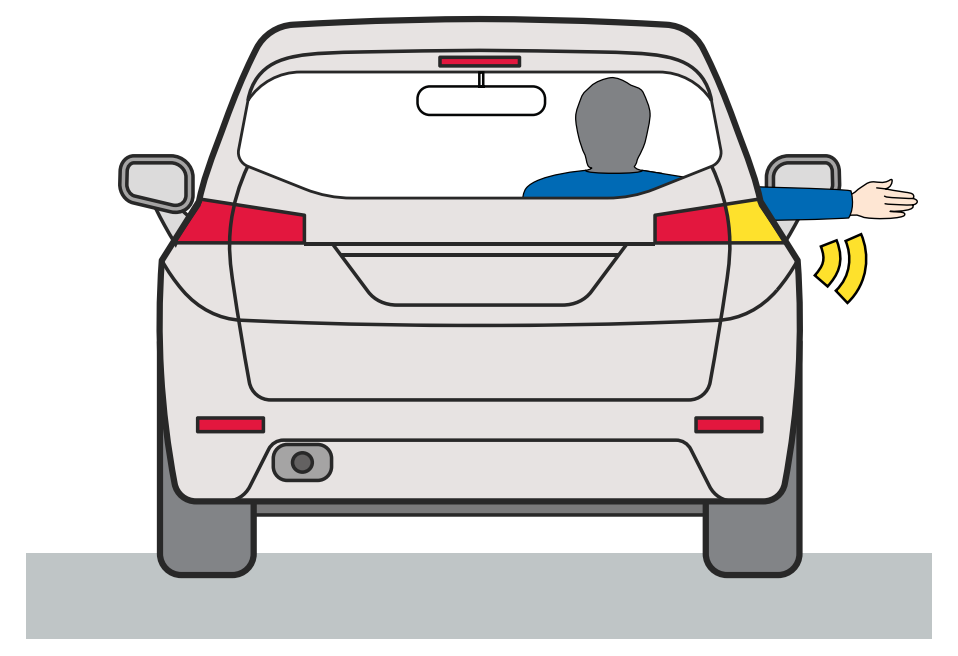
Turn right.
Turn left.
Stop the vehicle.
An outstretched right arm indicates the driver intends to turn right, warning other road users of the upcoming movement.
In which of the situations shown are you permitted to do a U-turn?
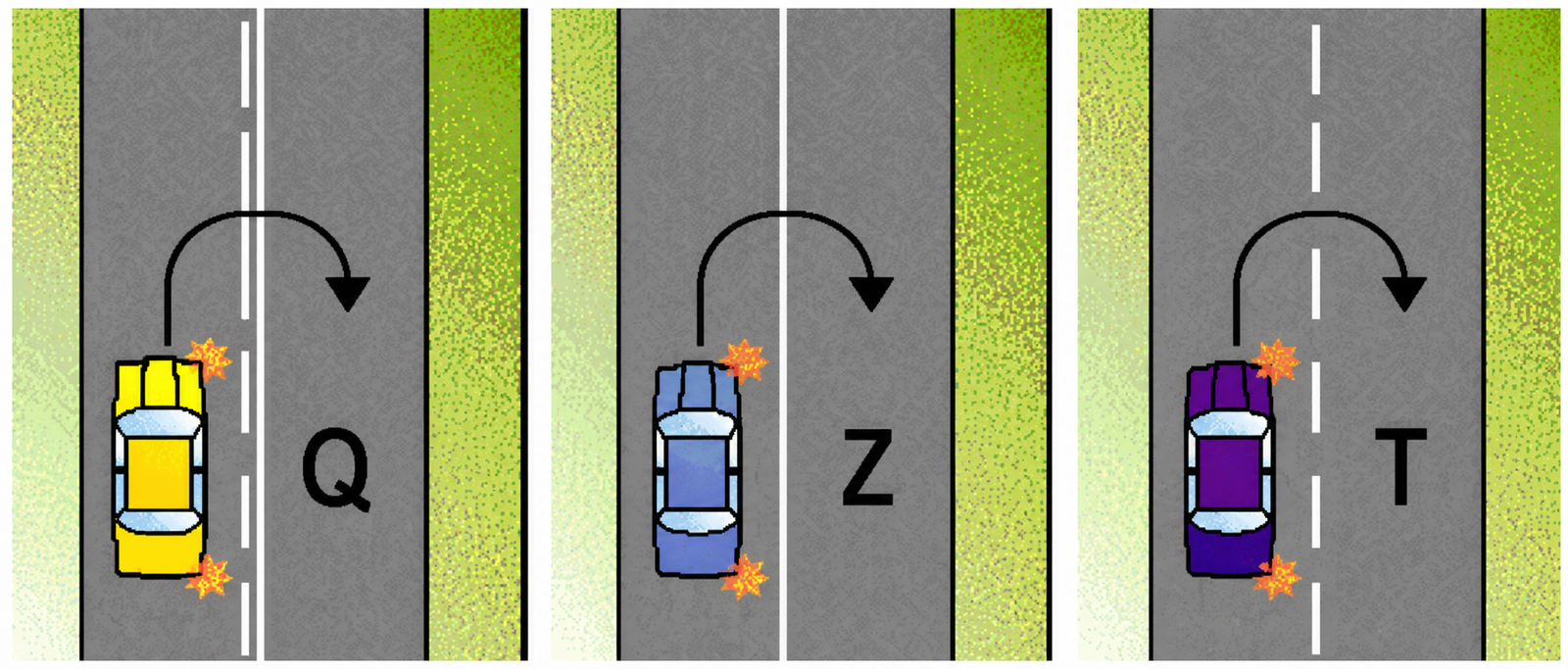
Only situation T is permitted.
Situations Q and T are permitted.
Situations T and Z are permitted.
You are only allowed to make a U-turn across a single broken (dashed) line. You must not cross a single continuous line (Q) or double continuous lines (Z) to make a U-turn.
What is the legal tread depth for tires in South Australia?
0.5 mm.
1.5 mm.
2.5 mm.
For safety and grip, especially on wet roads, tires must have a minimum tread depth of 1.5 mm across the entire tread surface.
In what order should the vehicles go through the intersection?
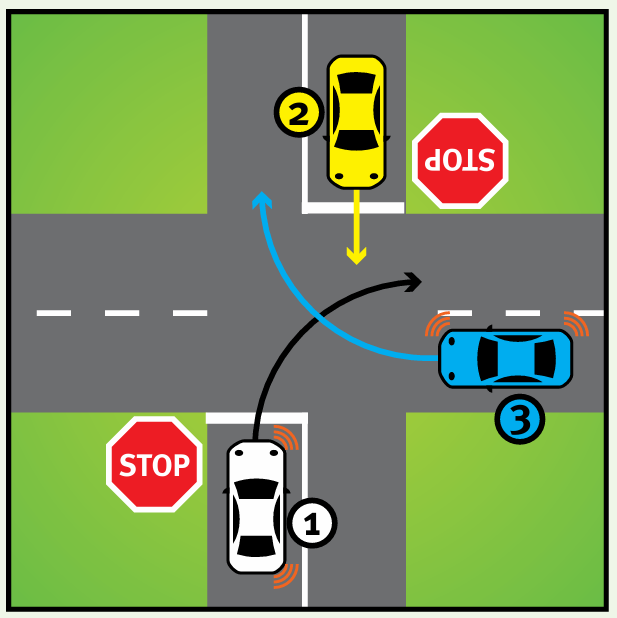
Vehicle 1, then vehicle 2, then vehicle 3.
Vehicle 3, then vehicle 2, then vehicle 1.
Vehicle 3, then vehicle 1, then vehicle 2.
Vehicle 3 proceeds first, then vehicle 2 goes straight, and vehicle 1 turns right after giving way.
'Dusk' is a dangerous time to drive because:
Light levels are changing, making it hard to see vehicles.
Street lights are not yet turned on in most areas.
Other drivers usually forget to turn on their park lights.
During dusk, the fading natural light creates shadows and reduces contrast, making it difficult to judge distances and spot other road users.
What does this sign indicate?
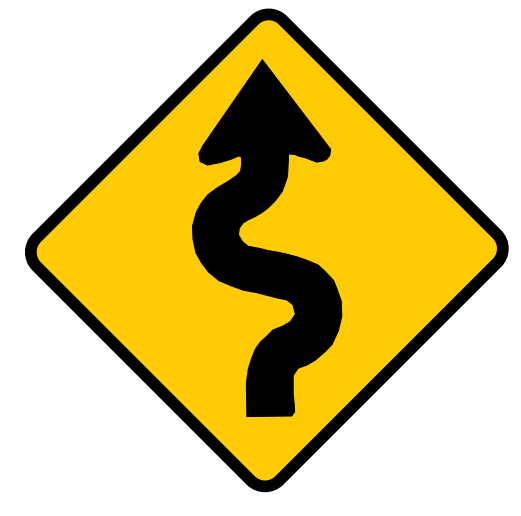
Winding road ahead.
Slippery road ahead.
First left then right turn.
This sign warns you that the road ahead has a series of curves or is "winding." You should slow down and drive carefully as visibility and handling may be affected.
If your car starts to skid on a wet road, you should:
Slam on the brakes.
Ease off the gas and steer into the skid.
Turn the steering wheel sharply the other way.
Sudden braking or sharp turning can make a skid worse. Easing off the gas and steering into the skid helps you regain traction and control.
If you are taking a long trip, how often should you stop for a rest?
Every 2 hours.
Every 4 hours to match fuel stops.
Only when you feel your eyes starting to close.
To prevent fatigue, you should take a break at least every 2 hours. Fatigue can slow your reactions and affect your judgment long before you realize you are tired.
What does this sign indicate?
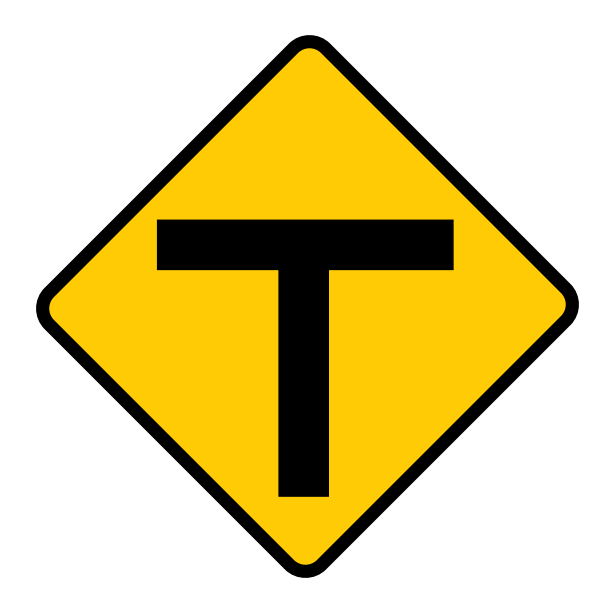
Traffic merges from the left.
The road turns into a highway.
The road you are on ends.
The road you are traveling on terminates. You must turn left or right and give way to traffic on the through-road.
Vehicle B is entering from a driveway, who must it give way to?
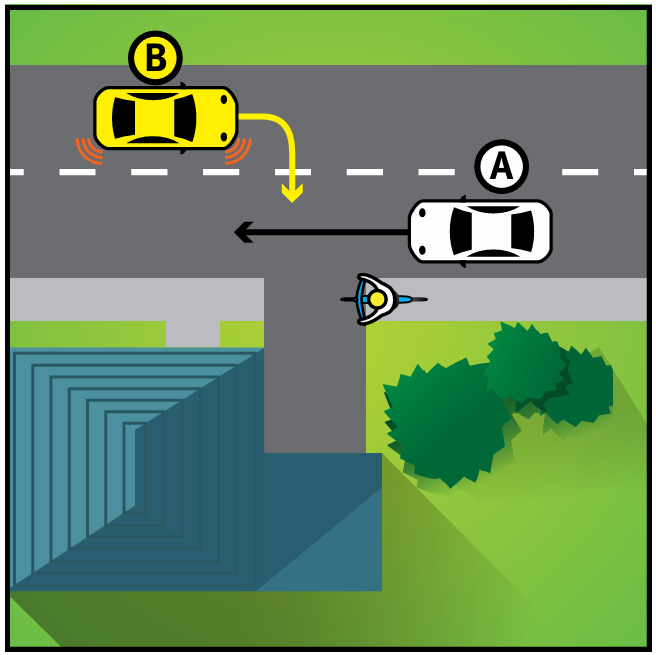
Only Vehicle A.
Only the bicyclist.
Vehicle A and the bicyclist.
When entering a road from a driveway, you must give way to all vehicles, pedestrians, and bicyclists already on the road.
What is the rule for using high-beam headlights when following another vehicle?
Use them at all times to see the road better.
Dip them when you are within 200 metres of the car in front.
Dip them only when the car in front flickers their lights at you.
You must dip your high-beam headlights within 200 metres of a vehicle ahead of you (or oncoming) to avoid dazzling other drivers and causing a safety hazard.
You are driving vehicle C. You must give way to:
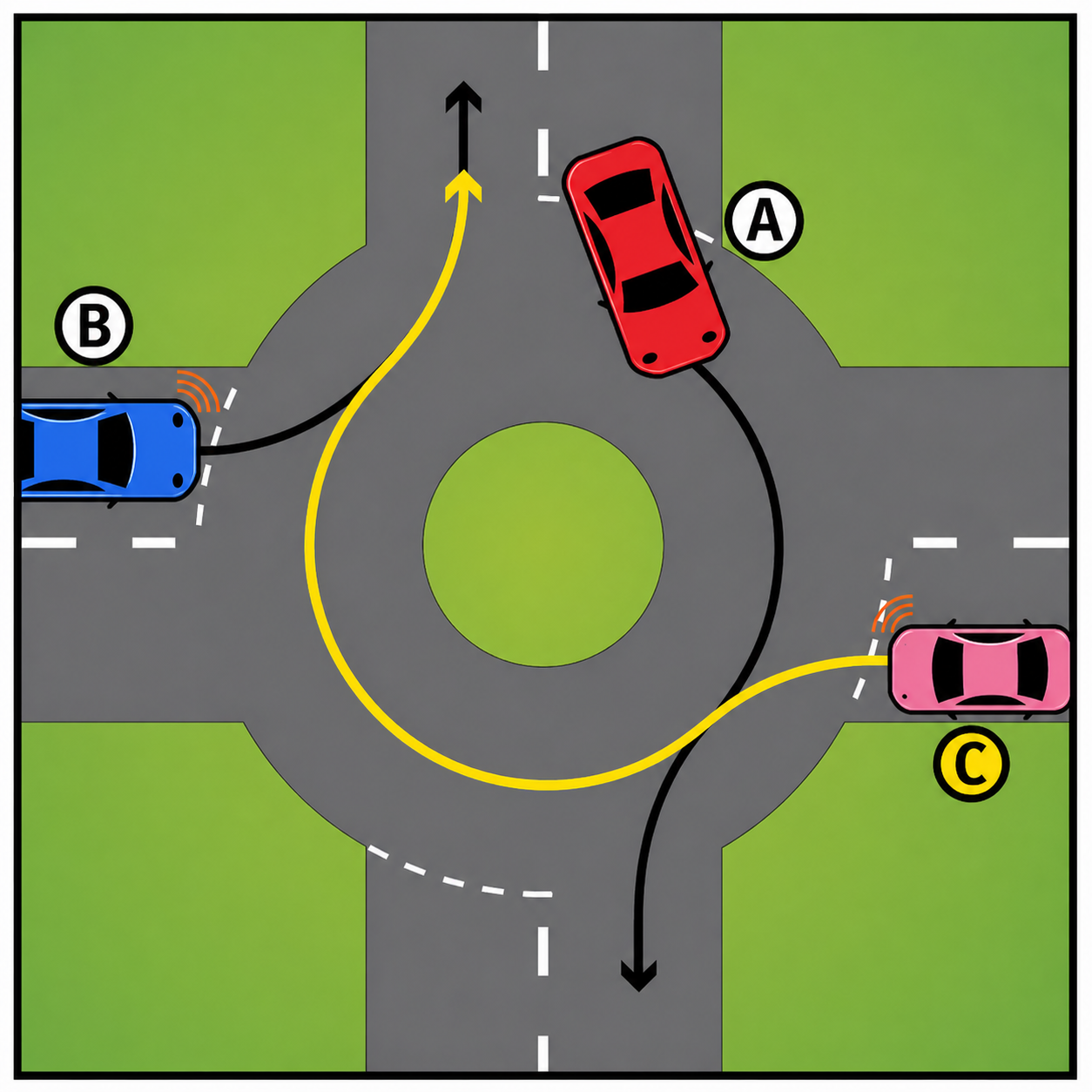
Vehicle A only.
Both vehicles A and B.
Neither vehicle A or B.
You must give way only to vehicles already on the roundabout, so vehicle C gives way to A but not to B.
What does this sign represent?
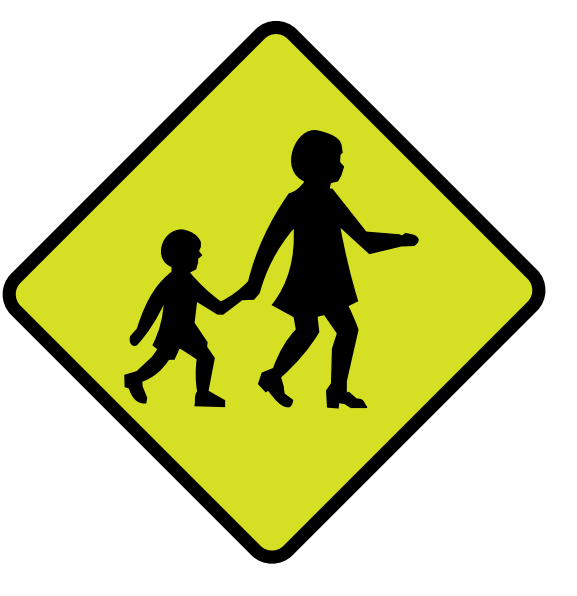
School zone ahead.
Pedestrian crossing only.
Children crossing ahead.
This sign warns that children may be crossing the road ahead, so drivers must slow down and be prepared to stop.
Based on this situation, which vehicle has the right of way?
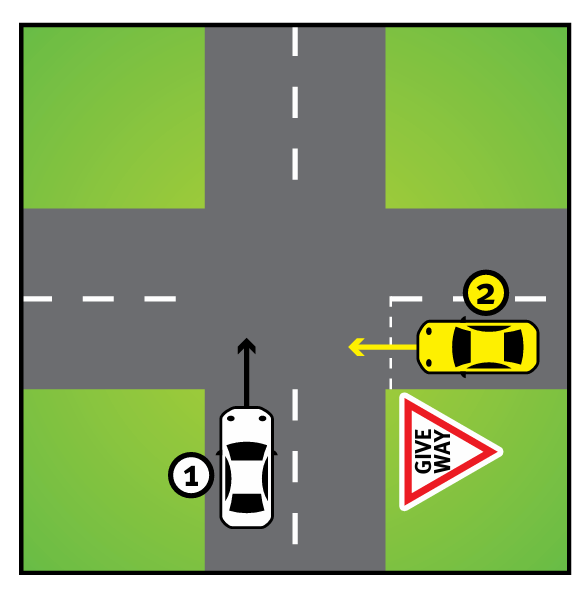
Vehicle 2.
Vehicle 1.
Both vehicles.
Vehicle 1 has the right of way because vehicle 2 must give way at the give way sign before entering the intersection.
In this situation, which vehicle must give way?
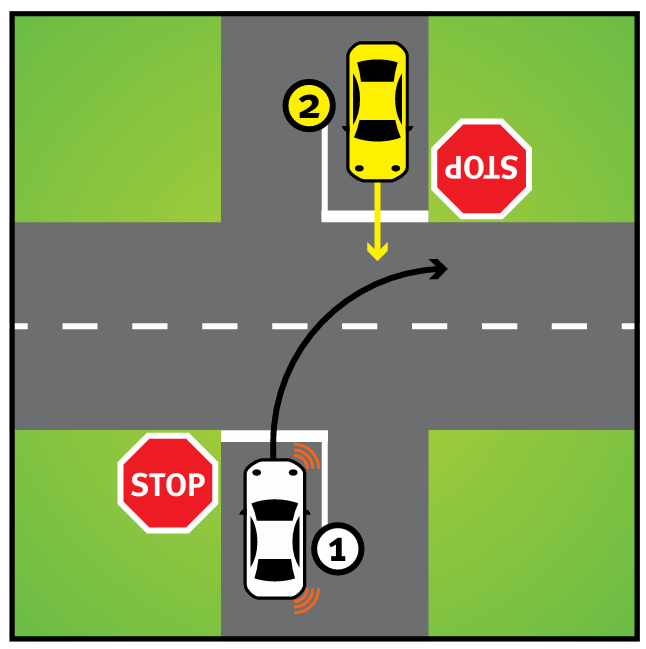
Vehicle 1.
Vehicle 2.
Both vehicles.
After stopping, vehicle 1 must give way to vehicle 2 because it is turning right across vehicle 2’s path.
At this uncontrolled intersection, who must give way to Vehicle 2?
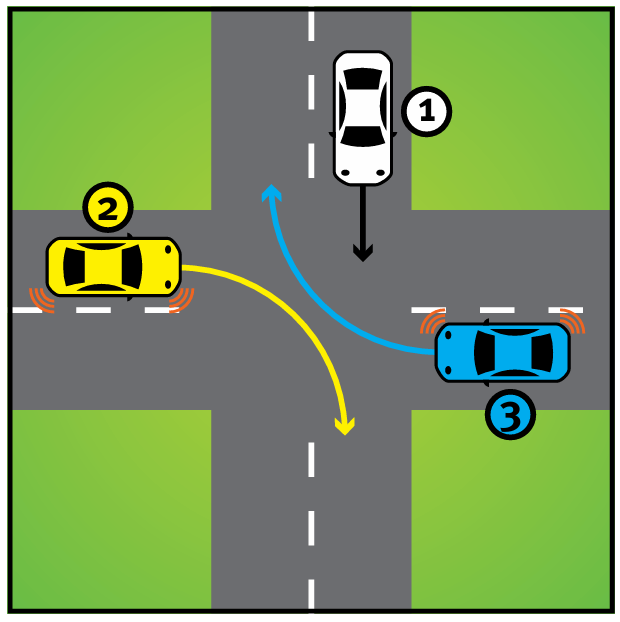
Only Vehicle 1.
Only Vehicle 3.
Both Vehicle 1 and 3.
At an uncontrolled intersection, you must give way to the right. Therefore, Vehicle 1 must give way to Vehicle 2, while Vehicle 3's path does not conflict.
You are Car A and want to overtake Car B on a two-lane road with a broken white line. When is it safe?
When you have a clear view and enough space.
When you are near a crest or a curve.
When the car in front of you speeds up to help you pass.
You must ensure the road ahead is clearly visible and there is a sufficient gap in traffic to complete the overtake without forcing other vehicles to change speed or direction.
A 'Shared Zone' sign with 10 km/h means:
Drivers must keep under 10 km/h and pedestrians must give way to cars.
Drivers must give way to pedestrians and keep under 10 km/h.
Drivers must keep under 10 km/h only when they see pedestrians on the road.
In a shared zone, pedestrians have priority over vehicles. You must drive at or below 10 km/h and be prepared to stop for anyone walking in the area.
You are driving in a tunnel. What should you do?
Keep your windows down.
Drive as fast as possible to get out.
Turn on your headlights (low beam).
Tunnels often have lower light levels. Turning on your headlights helps you see clearly and makes your vehicle visible to others.
If your car breaks down on a highway, you should:
Stay in the car in the middle of the lane.
Walk along the highway to find a petrol station.
Pull over to the shoulder, turn on hazard lights, and stay safe.
Move the car off the road and use hazard lights to warn others and avoid collisions.
What does this sign mean?
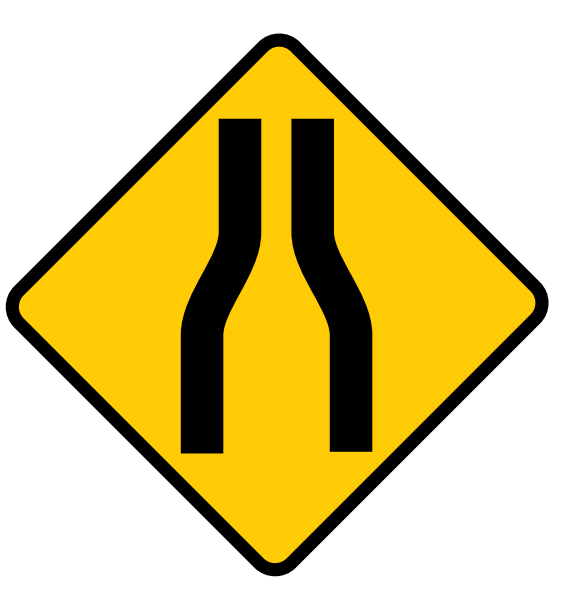
Two-way traffic ahead.
Narrow bridge ahead.
Road narrows ahead.
This sign warns that the road becomes narrower on both sides, so drivers must reduce speed and be cautious of reduced space.
When must you give a signal (indicator) before turning?
1 metre before the turn.
Long enough to give plenty of warning to others.
Only after you start turning.
You must signal long enough before starting the turn to ensure other drivers have plenty of time to see your indicator and react.
When is the road surface most slippery?
After it has been raining for hours.
On a very hot dry day.
Just after it starts to rain.
When it first begins to rain, water mixes with oil and dust on the road surface to create a very slippery film. After raining for hours, this mixture is usually washed away.
If you are a 'P1' driver, what is your maximum speed limit in SA?
110 km/h.
100 km/h.
90 km/h.
In South Australia, even if the posted road speed limit is 110 km/h, P1 (and P2) license holders must not exceed a maximum speed of 100 km/h.
You are driving Vehicle 1. Your lane ends and you must change lanes. Who must give way?
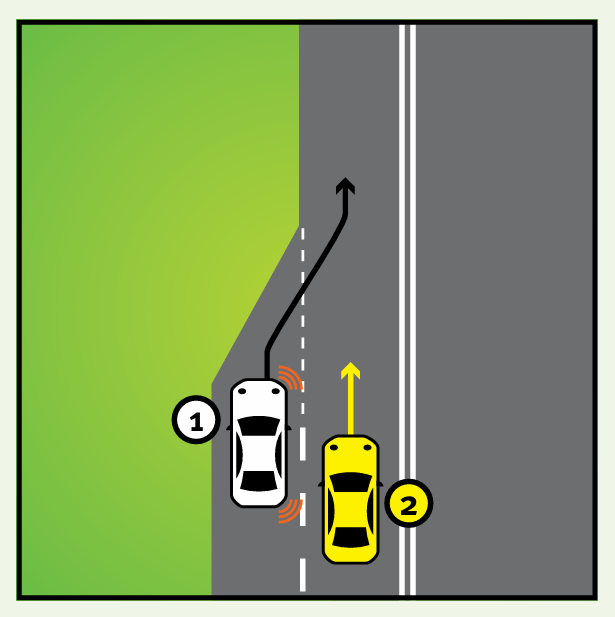
Vehicle 1 must give way to Vehicle 2.
Vehicle 2 must give way to Vehicle 1.
Both vehicles share equal priority.
When changing lanes, you must give way to vehicles already in the lane you are entering.
What does this sign mean?
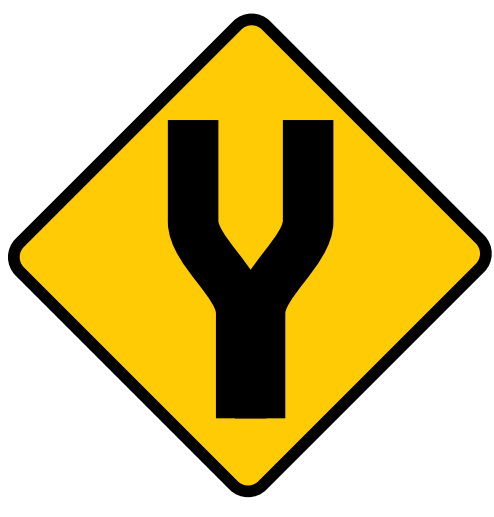
Y-junction ahead.
Divided road ends.
Road divides ahead.
This sign warns that the road ahead splits into two separate one-way directions, so drivers must choose the correct side to continue safely.
Which vehicle should give way at this roundabout?
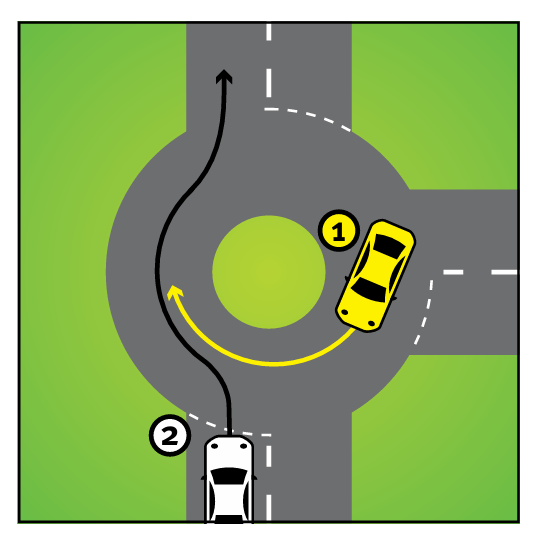
Vehicle 1 must give way to Vehicle 2.
Vehicle 2 must give way to Vehicle 1.
Both proceed without giving way.
Vehicles in the roundabout have priority. Vehicle 1 is already inside, so Vehicle 2 must give way before entering.