Syllabus: Tasmanian Road Rules Handbook (2026)
TAS DKT: Full Practice Test B
Complete practice set for the Tasmania Driver Knowledge Test.
Part 1: General Knowledge
15 Practice Questions
Part 2: Road Safety
20 Practice Questions
Question Format
Multiple Choice (35 Total)
⚠️ Practice Mode: This is a relaxed study session. You can complete all 35 questions to review the correct answers, even if you make a mistake.
Start Practice Test B
Ready to master the questions?
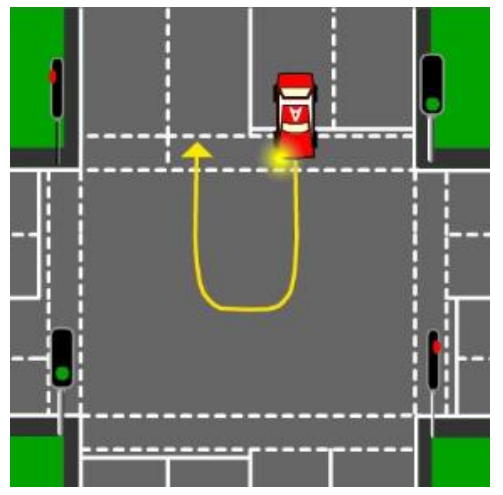
At an intersection with traffic lights, when can you make a U-turn?
Between 9 p.m. and 6 a.m.
When no oncoming traffic is present.
When the lights are green.
Only when a “U-turn permitted” sign is shown.
At intersections with traffic lights, U-turns are only allowed when a sign specifically permits them, regardless of signal colour or traffic conditions.
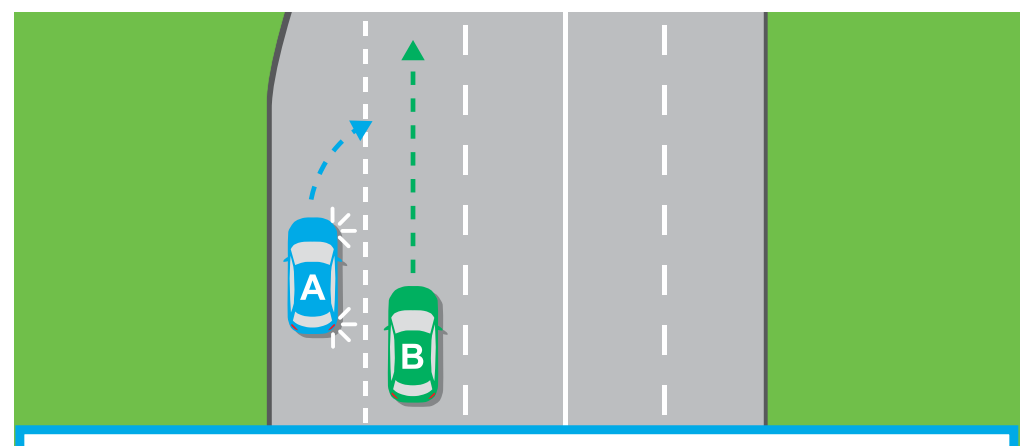
Car A’s lane is ending and it wants to move into Car B’s lane. Who must give way?
Car A.
Car B.
Both cars.
Neither car.
A driver leaving a lane must give way to traffic already in the lane being entered, so Car A must give way to Car B.
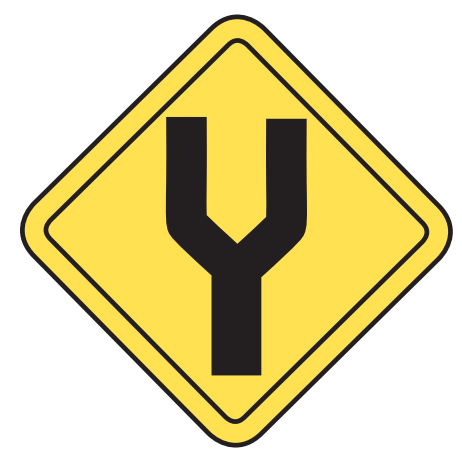
What does this sign indicate?
Divided road ahead.
Divided road ends.
Narrow road ahead.
Narrow bridge ahead.
This warning sign indicates that the road ahead will be divided by a median or barrier separating traffic in opposite directions.
When you see a ‘Clearway’ sign, it means:
No stopping or parking at any time.
No parking, but stopping briefly is allowed.
Parking allowed for short periods only.
Stopping allowed if traffic is light.
A Clearway means you must not stop or park at any time, as the road must remain clear to maintain continuous traffic flow.
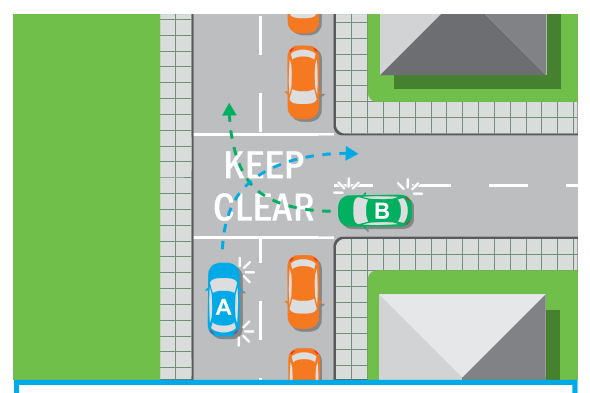
At this intersection with a “KEEP CLEAR” marking, which car must give way?
Car B.
Car A.
Both cars.
Neither car.
Vehicles must not stop in a keep-clear area, so Car B must give way and wait until the path is clear before entering.
When moving from the side of the road into traffic, how long must you indicate?
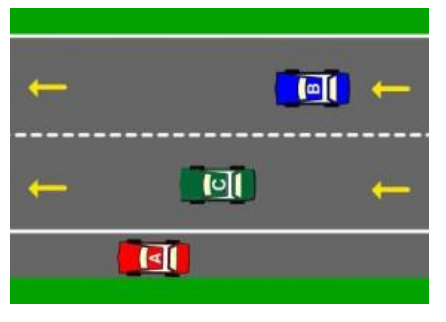
For 1 second and give way.
For 3 seconds and give way.
For 5 seconds and give way.
Only if traffic is coming.
Before moving into traffic, you must indicate for at least 3 seconds and give way to all vehicles already in the traffic lane.
What does this sign mean?
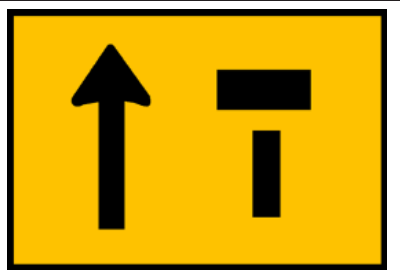
Trucks must use right lane.
T-intersection ahead.
Left lane closed, right lane open.
Left lane open, right lane closed.
This lane designation sign shows the right lane is closed ahead, so traffic must continue in the left lane.
When must you use your indicators?
When other vehicles may be affected.
Only when driving at night.
Whenever turning or changing lanes.
Only at signalised intersections.
You must always signal your intention to turn or change lanes to give other road users, including pedestrians and cyclists, plenty of warning, even if you think no one else is around.
When turning at an intersection, which lane should you use?
The widest lane available.
The least busy lane.
The fastest-moving lane.
The correct turning lane for your direction.
You must turn from and into the correct lane as marked or required, ensuring safe and predictable movement for other road users.
Car B has stopped at a pedestrian crossing ahead of you. You must:
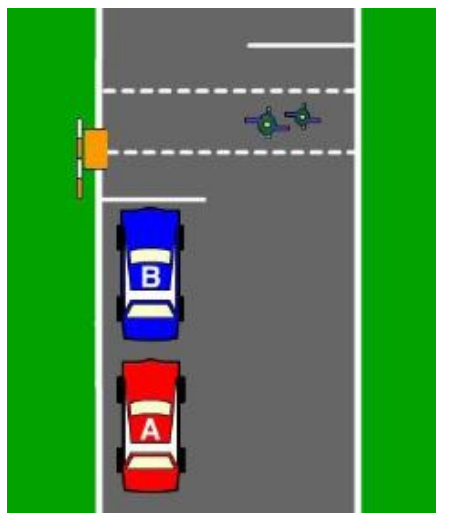
Overtake Car B.
Overtake if no pedestrians are visible.
Stop behind Car B.
Sound horn and pass carefully.
You must not overtake a vehicle stopped at a pedestrian crossing, as pedestrians may be crossing and not visible.
What is the legal BAC limit for a fully licensed driver?
0.08.
0.00.
0.05.
0.10.
Fully licensed drivers must keep their BAC below 0.05, as this is the legal limit; exceeding it is an offence.
Are you allowed to drive with a person or animal in your lap?
No, it is illegal and dangerous.
Yes, if driving slowly.
Only on a private road.
Only for a short distance.
Having a person or animal in your lap interferes with vehicle control and is illegal because it creates a serious safety risk.
Car A is entering a road from a side street. Who must Car A give way to?
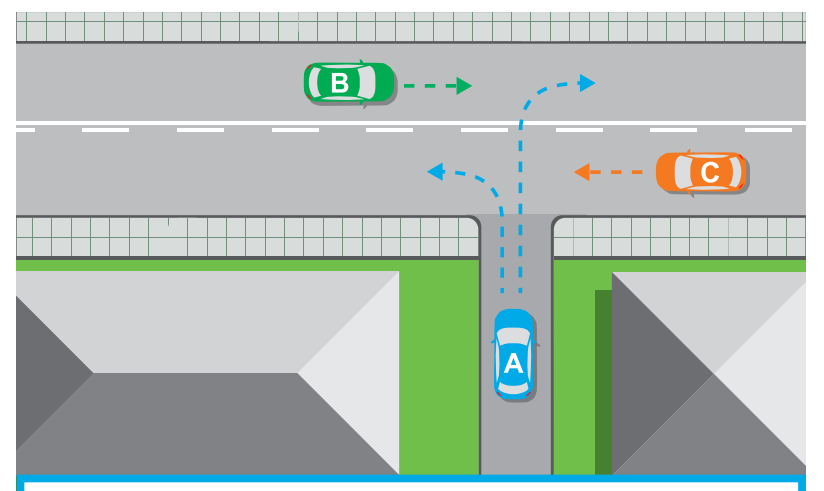
Car B only.
Car C only.
Both Car B and Car C.
Neither car.
A vehicle entering a road must give way to all traffic already on that road, including vehicles from both directions.
When parking uphill with a kerb, which way should you turn your wheels?
Towards the kerb.
Away from the kerb.
Straight ahead.
Slightly towards the road.
When parked uphill with a kerb, turning wheels away ensures the vehicle rolls back into the kerb if it moves, helping prevent it from rolling into traffic.
If you see a ‘2P’ parking sign, it means:
Parking allowed for at least 2 hours.
Maximum parking time is 2 hours.
Only 2 vehicles may park.
Parking allowed twice per day.
A ‘2P’ sign sets a time limit, meaning you can park for up to 2 hours during the indicated period, not longer.
When you see a GIVE WAY sign, you must:
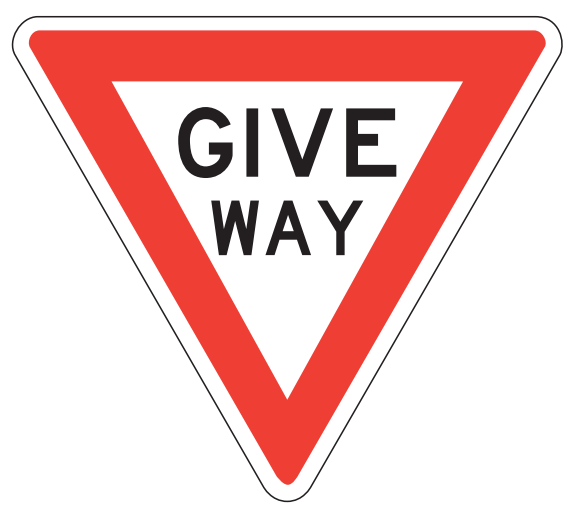
Slow down and check traffic only.
Slow down, be ready to stop, and give way.
Continue if the road looks clear.
Stop only if other vehicles are close.
A GIVE WAY sign requires you to slow down, assess traffic, and give way to all vehicles, stopping if necessary to avoid conflict.
How close to a pedestrian crossing can you park?
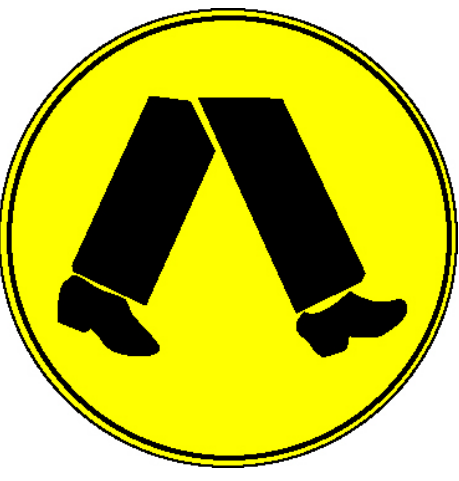
5 m on either side.
3 m before and 5 m after.
15 m on either side.
20 m before and 10 m after.
You must not park within 5 metres of a pedestrian crossing on either side to ensure clear visibility and safety for pedestrians.
When can you use a handheld mobile phone while driving?
Only when stopped at traffic lights.
Never while driving, even when stopped in traffic.
Only for quick text messages.
Only when driving at low speeds.
It is illegal to use a handheld phone while driving, including when stopped in traffic, because you are still in control of the vehicle.
At this intersection, who must Car A give way to?
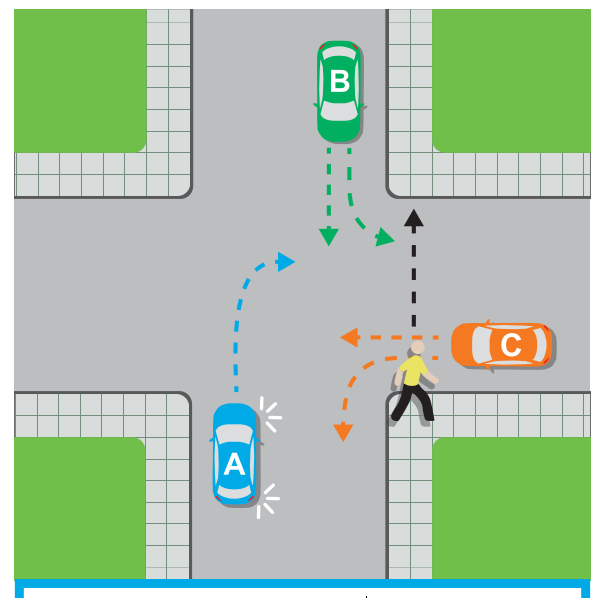
Car B only.
Car C only.
Car B and Car C.
Car B, Car C and the pedestrian.
A turning vehicle must give way to all vehicles on the road being entered and to pedestrians crossing, so Car A must give way to both cars and the pedestrian.
Car A is at a STOP sign entering the intersection. Who must Car A give way to?
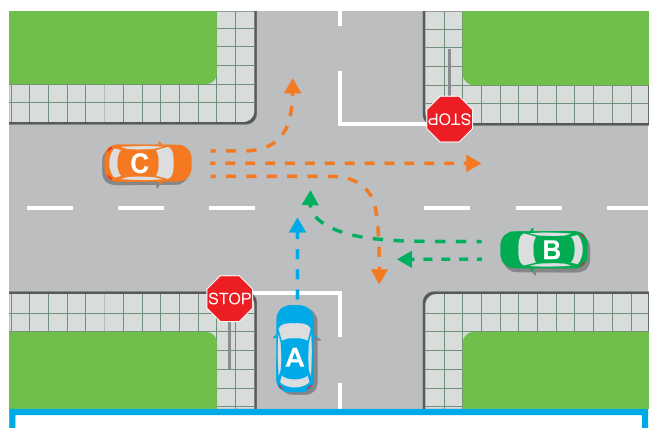
Car B only.
Car C only.
Car B and Car C.
Neither car.
A driver at a STOP sign must give way to all traffic on the road they are entering, including vehicles from both directions.
You are driving in heavy rain and your vision is limited. You should:
Use high beams.
Speed up to clear the area.
Use low beams and increase following distance.
Maintain the same speed.
In heavy rain, low beams improve visibility without glare, and increasing distance gives more time to react safely to reduced visibility and road grip.
If an emergency vehicle is behind you with sirens or flashing lights, you must:
Speed up to stay ahead.
Move left and give way.
Stop immediately in the road.
Continue driving normally.
You must move safely to the left and give way so the emergency vehicle can pass quickly without obstruction.
How far from an intersection (no traffic lights) must you park?
At least 5 metres.
At least 10 metres.
At least 20 metres.
Parking allowed at the corner.
You must park at least 10 metres away from an intersection without traffic lights to maintain visibility and allow safe movement of vehicles.
If you have not slept for 24 hours, driving is equivalent to:
Driving slightly tired.
A blood alcohol level below the legal limit.
Driving at normal alertness.
A blood alcohol level about twice the legal limit.
Being awake for 24 hours impairs driving ability to a level similar to having a BAC around 0.10, which is about twice the legal limit.
What is the only thing that will sober you up after drinking alcohol?
A cold shower.
Black coffee.
Eating a heavy meal.
Time.
Only time allows the body to process and remove alcohol from the bloodstream, while other methods may make you feel alert but do not reduce intoxication.
When turning right from one one-way street into another, you should turn from:
The far left lane.
Any clear lane.
The far right lane.
The middle of the road.
When turning right from a one-way street, you must start from the far right lane and turn into the corresponding lane to maintain correct road positioning.
What does this sign represent?
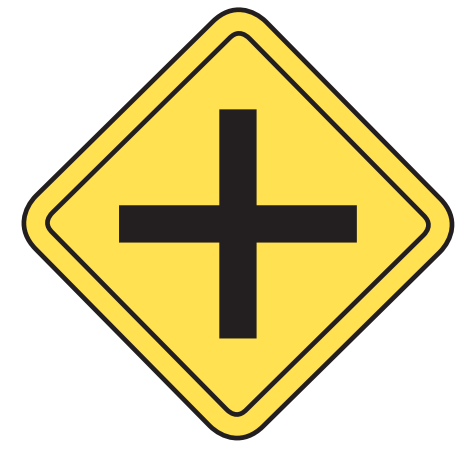
Crossroad intersection ahead.
Double T-intersection ahead.
Railway crossing ahead.
Hospital ahead.
This warning sign indicates a four-way intersection ahead where roads cross, so drivers should be prepared for traffic from all directions.
On multi-lane roads over 80 km/h, you must:
Stay in the right lane.
Use any lane freely.
Stay in the middle lane.
Keep left unless overtaking or turning right.
On higher-speed multi-lane roads, you must keep left and only use other lanes for overtaking or turning right to maintain smooth traffic flow.
When overtaking a bicycle at 60 km/h or below, what minimum distance must you keep?
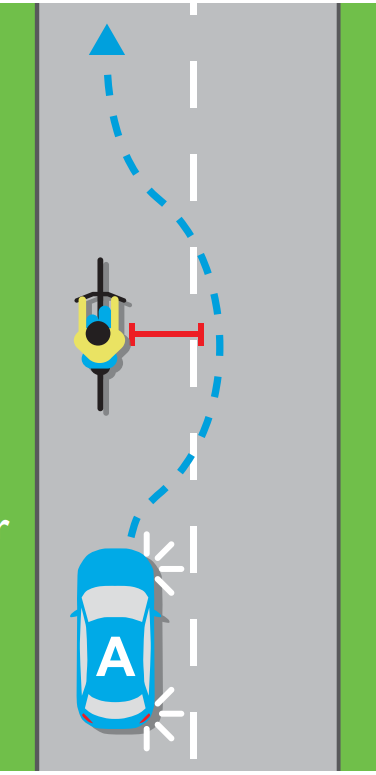
At least 1 metre.
At least 1.5 metres.
About 2 metres if safe.
Any safe distance.
At speeds of 60 km/h or less, you must keep a minimum lateral distance of 1 metre when passing a bicycle to ensure rider safety.
What does a yellow arrow at a traffic light mean?
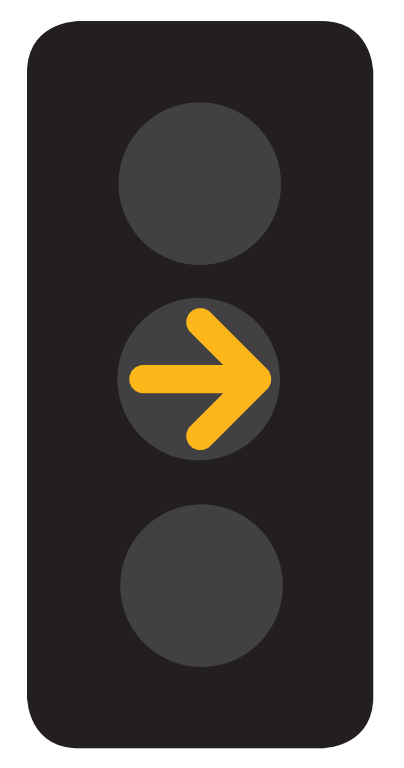
Turn immediately without stopping.
Continue turning without caution.
Stop unless it is unsafe to do so.
Wait for a green arrow only.
A yellow arrow means the turning movement is ending, so you must stop before the line unless it is unsafe to do so.
In a 110 km/h zone, what is the maximum speed for a learner driver?
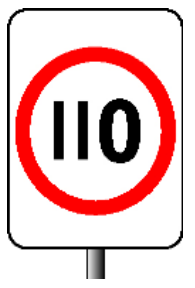
110 km/h.
100 km/h.
80 km/h.
90 km/h.
Learner drivers are restricted to a maximum of 90 km/h regardless of higher posted speed limits, so they must not exceed this limit even in a 110 km/h zone.
Can you perform a U-turn across a single continuous line?
Yes, if there is no traffic.
No, it is illegal.
Only during the daytime.
Only if the road is wide.
You must not cross a single or double continuous line to make a U-turn. You can only make a U-turn where there is a broken line or no line at all, provided it is safe.
In built-up areas with no speed sign, what is the default speed limit?
80 km/h.
100 km/h.
30 km/h.
50 km/h.
In built-up areas, the default speed limit is 50 km/h unless a different limit is indicated by signs.
On a gravel road, your stopping distance will:
Increase due to reduced traction.
Reduce due to less grip.
Remain similar to sealed roads.
Vary only with daylight conditions.
Gravel surfaces provide less grip than sealed roads, increasing stopping distance and requiring more caution and lower speeds.
When overtaking another vehicle, which is NOT allowed?
Using your indicator.
Exceeding the speed limit.
Checking mirrors.
Leaving enough space.
While overtaking, you must still follow the speed limit, whereas signalling, checking mirrors, and leaving space are required safe practices.