Syllabus: Tasmanian Road Rules Handbook (2026)
TAS DKT: Full Practice Test C
Complete practice set for the Tasmania Driver Knowledge Test.
Part 1: General Knowledge
15 Practice Questions
Part 2: Road Safety
20 Practice Questions
Question Format
Multiple Choice (35 Total)
⚠️ Practice Mode: This is a relaxed study session. You can complete all 35 questions to review the correct answers, even if you make a mistake.
Start Practice Test C
Ready to master the questions?
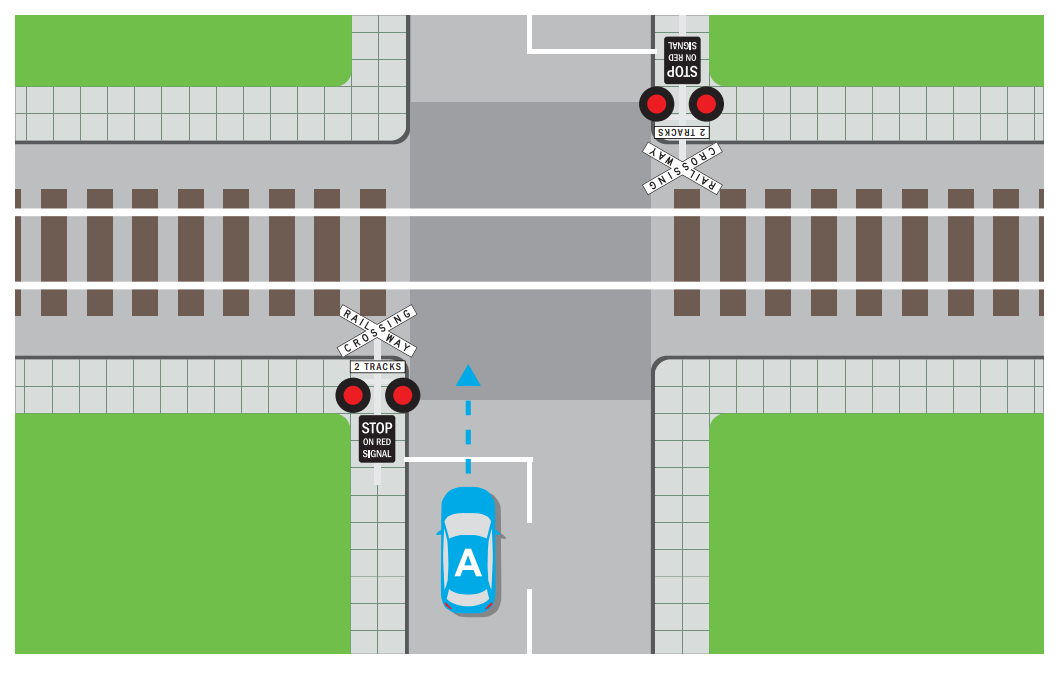
You are driving Car A approaching this level crossing. What should you do?
Slow down and proceed if no train is seen.
Cross if the road ahead is clear.
Stop only if warning lights are flashing.
Stop and give way to any train.
At a STOP sign and line at a level crossing, you must come to a complete stop and give way to any approaching train before crossing.
When approaching a railway crossing without lights, you must:
Stop only if you see a train approaching.
Speed up to cross as quickly as possible.
Follow the vehicle ahead without stopping.
Slow down, look both ways and listen.
At crossings without lights, you must slow down, check both directions, and listen for trains, as there are no signals to warn you.
What is the rule about using high beams?
Use them whenever the road is dark.
Dip them within 200 metres of another vehicle.
Dip them within 500 metres of another vehicle.
Keep them on if no vehicles are close.
The legal requirement is 200 metres. While dipping earlier is polite, the law specifically tests if you know the exact distance of 200 metres.
When approaching a pedestrian crossing, you must:
Slow down and prepare to stop.
Stop only if they are halfway across.
Sound your horn to warn them.
Speed up to cross quickly.
You must give way as soon as a pedestrian steps onto the crossing, not just when they reach the middle.
When you see a “Keep Left” sign, you must:
Choose either side if clear.
Pass to the right of the sign.
Pass to the left of the sign.
Stop before the sign.
A “Keep Left” sign requires drivers to pass on the left side of the obstruction or sign to maintain correct traffic flow.
While driving, you are distracted by a mobile phone. This will:
Increase your reaction time.
Decrease your reaction time.
Have little effect at low speeds.
Only be dangerous at high speeds.
Mobile phone distraction slows down your physical and mental response to hazards. This "increased reaction time" is dangerous regardless of whether you are driving fast or slow.
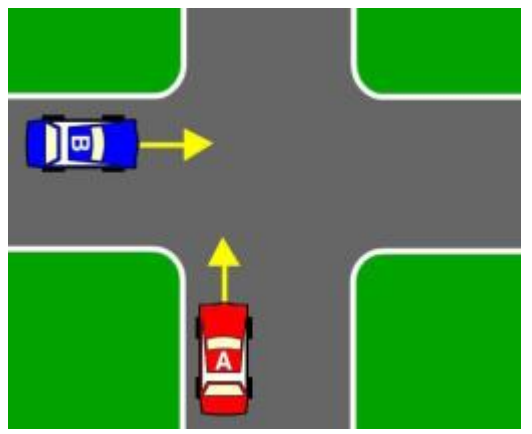
In this situation, which vehicle must give way?
Car A.
Car B.
Both Car A and Car B.
Neither car.
At an uncontrolled intersection, you must give way to vehicles on your right. Car A is on Car B’s right, so Car B must give way.
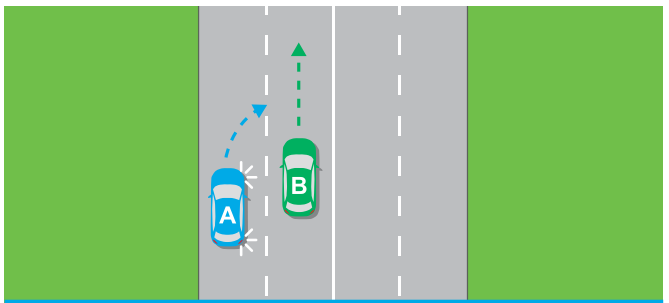
In this situation, which vehicle must give way?
Car A.
Car B.
Both Car A and Car B.
Neither car.
When changing lanes, you must give way to vehicles already in the lane you are entering. Car A is moving into Car B’s lane, so Car A must give way.
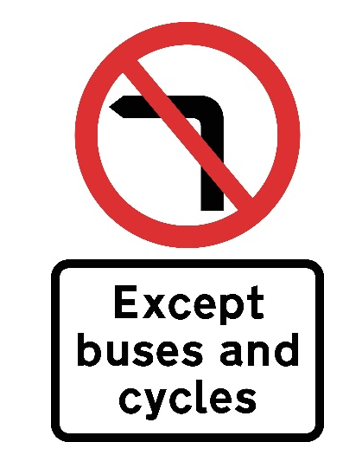
You are driving a car. What must you do when you see this sign?
Turn left as indicated.
Turn left if no buses or cycles.
Only buses and cycles must turn left.
You must not turn left.
The “No Left Turn” sign applies to all vehicles except those specified, so only buses and cycles may turn while all other vehicles are prohibited.
What does this green arrow indicate?
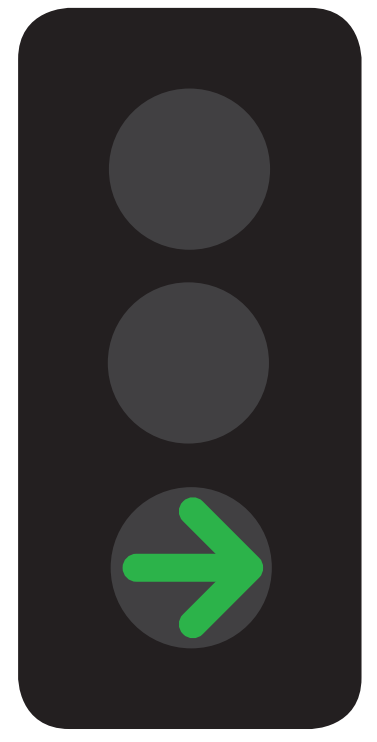
Turn right without stopping.
You may turn right, giving way if required.
Stop before turning right.
Wait for a full green light.
A green arrow allows you to turn in that direction, but you must still give way to pedestrians or other road users if necessary.
When involved in a traffic crash, what information must you exchange?
Name, address, and vehicle details.
Name and Driver's licence number only.
Name and insurance details only.
Name and phone number only.
You must provide your name and address, and the registration number of the vehicle you are driving. If you are not the owner, you must also provide the owner's name and address.
In this situation, which car can cross the lines to overtake (when safe)?
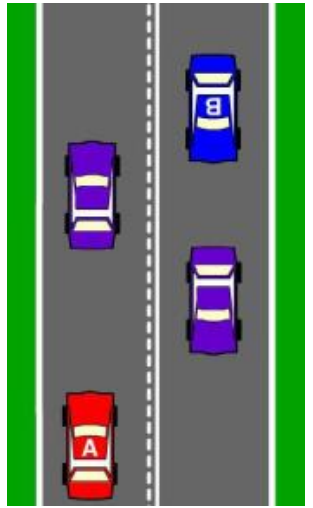
Car B.
Car A.
Both Car A and Car B.
Neither car.
A broken line on your side allows crossing to overtake, while a solid line prohibits it. Car A is on the broken-line side, so only Car A can cross.
What is the BAC limit for a supervisor of a learner driver?
Less than 0.08.
Less than 0.05.
0.00.
Same as the learner driver.
A supervising driver must meet the standard licensed driver BAC limit (below 0.05), as they are legally responsible for the learner’s driving.
What does this hand signal mean?
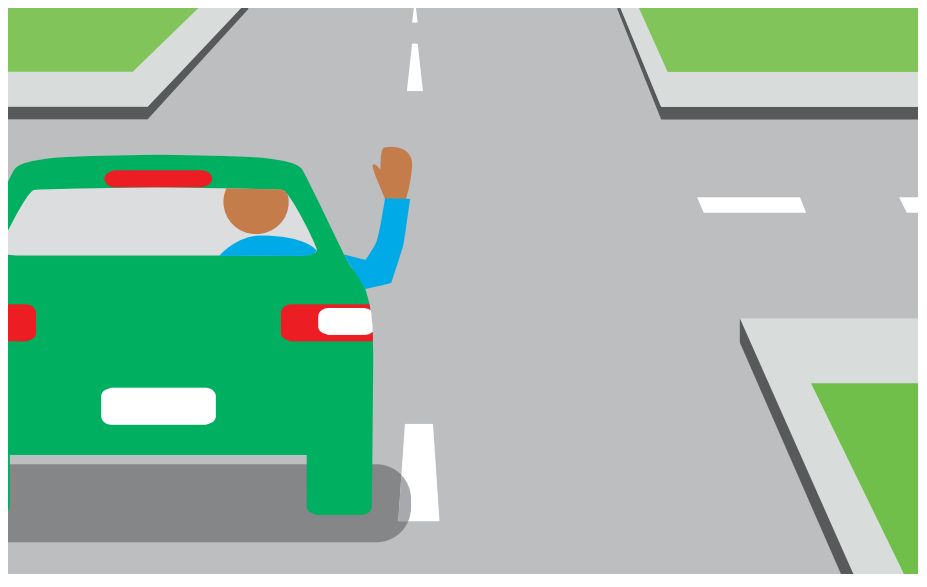
Turning right.
Turning left.
Overtaking.
Slowing down or stopping.
A driver extending their right arm upward indicates that they are slowing down or stopping, warning vehicles behind to reduce speed.
You are at a roundabout and want to go straight ahead. You must:
Signal left as you approach.
Signal right as you approach.
Do not signal on approach; signal left before exiting.
Use hazard lights while passing.
When going straight at a roundabout, you do not signal on entry, but you must signal left before exiting to inform other drivers.
What does this sign represent?
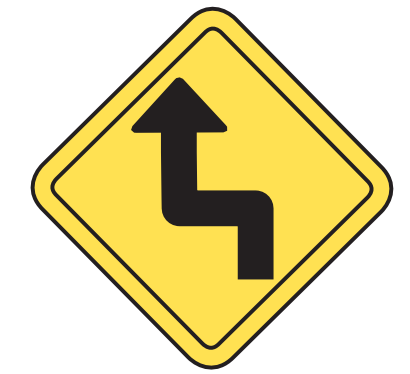
Winding road ahead.
Left turn ahead.
Sharp bend ahead.
Road merges ahead.
This warning sign indicates a sharp change in direction ahead, requiring you to slow down and prepare to turn safely.
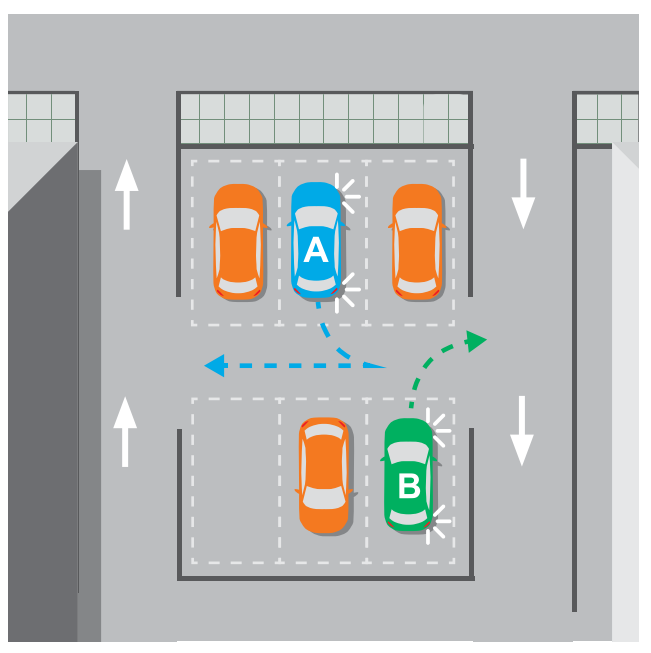
In this situation, Car A is moving out of a parking space. Which vehicle must give way?
Car B.
Car A.
Both Car A and Car B.
Neither car.
A driver entering or leaving a parking space, including reversing, must give way to all vehicles already on the road.
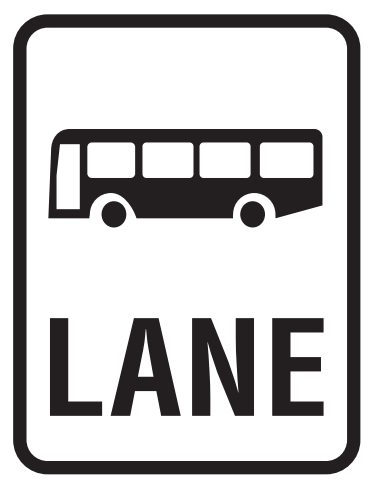
If you see a 'Bus Lane' sign, when can you drive in that lane?
To overtake slower traffic.
Anytime no bus is visible.
To make a turn, for up to 100 metres.
To make a turn, for up to 300 metres.
You may enter a bus lane briefly (up to about 100 metres) only to make a turn, not for overtaking or general driving.
Can you use hazard lights while your vehicle is moving?
Yes, to increase visibility in poor conditions.
Yes, when driving slowly in traffic.
Only in emergencies or when you are a hazard.
Only when stopped on the roadside.
Hazard lights may be used while moving only in emergencies when your vehicle poses a danger, to warn other road users.
If you are taking prescribed medicine, what should you do before driving?
Drive normally unless you feel unwell.
Check the label or ask if it affects driving.
Drive only for short distances.
Avoid driving only at high speeds.
Some medicines can impair alertness or reaction time, so you must confirm their effects before driving to ensure safety.
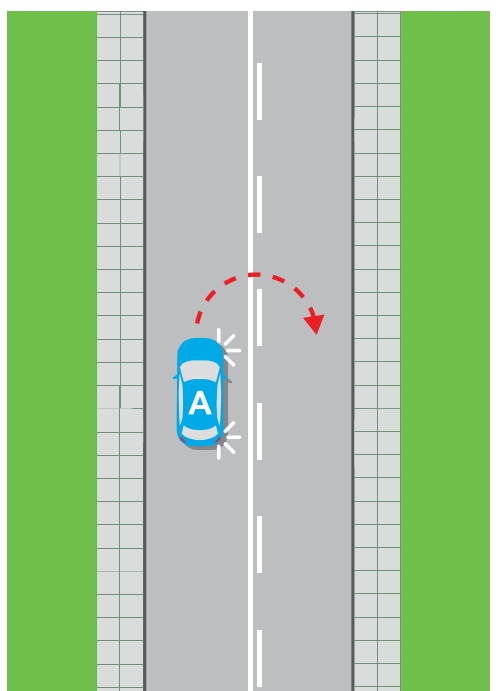
In this situation, can Car A make a U-turn?
No, it is not permitted.
Yes, if the road is clear.
Yes, at any time.
Only at low speed.
You must not make a U-turn across a continuous (solid) centre line, as crossing it is prohibited for turning or overtaking.
Why is speeding dangerous?
It increases stopping distance and impact force.
It decreases stopping distance and impact force.
It reduces the time to react.
It affects fuel use more than safety.
Higher speeds increase both stopping distance and crash impact, while also reducing the time available to react to hazards.
When can you drive over a painted island?
To overtake if traffic is slow.
To avoid traffic congestion.
To enter or leave the road, or a turning lane if safe.
Never, it is always illegal.
Driving over a painted island is only allowed for specific purposes like entering or leaving a road or turning lane, and only when it is safe to do so.
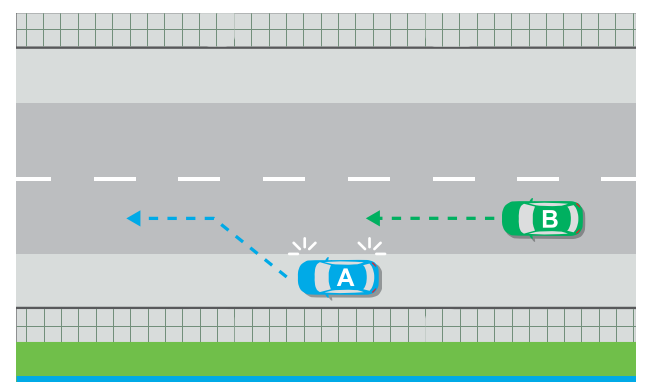
In this situation, which vehicle must give way?
Car B.
Car A.
Both Car A and Car B.
Neither car.
When turning across the path of another vehicle, you must give way to traffic already travelling in that lane. Car A is turning across Car B’s path, so Car A must give way.
What is the rule regarding seatbelts?
Only the driver and front passenger.
Everyone in the vehicle must wear one.
Only required on highways.
Not needed if the car has airbags.
All occupants must wear a seatbelt where one is fitted, as it is a legal requirement regardless of seating position, road type, or vehicle features like airbags.
When driving on a slippery road, you should:
Brake hard to stay in control.
Drive at a speed appropriate for conditions.
Keep a shorter following distance.
Speed up to avoid sliding.
On a slippery road, sudden actions like hard braking or speeding up can cause you to lose traction. You must slow down and increase your following distance to stay safe.
If you are overtaking a cyclist, you should:
Just enough space to pass safely.
At least 2 metres regardless of speed.
Overtake quickly with minimal clearance.
At least 1 m (up to 60 km/h) or 1.5 m (over 60 km/h).
You must leave a minimum of 1 metre when the speed limit is 60km/h or less, and 1.5 metres when it is over 60km/h. This is a legal requirement in most Australian states to protect cyclists.
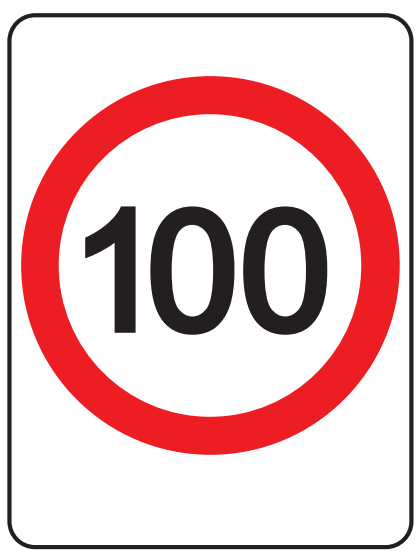
What does a default speed limit of 100 km/h apply to?
Built-up areas.
Unsealed roads outside built-up areas.
All roads without signs.
Sealed roads outside built-up areas.
A default speed limit of 100 km/h applies to sealed roads outside built-up areas when no other speed limit signs are present.
What is the safest way to travel with a small child in a car?
Holding them securely in your arms.
In the front seat with a standard seat belt.
In an approved restraint suitable for their size.
In the back seat with a normal seatbelt.
A child must be secured in an approved restraint suited to their size and weight, as adult seatbelts or holding them do not provide proper protection in a crash.
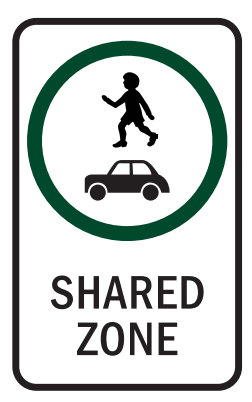
When driving in a shared zone, you must:
Give way only at crossings.
Drive normally if no pedestrians are nearby.
Give way only to children.
Give way to all pedestrians.
In a shared zone, pedestrians have priority at all times, so drivers must give way and drive carefully at low speed.
When two lanes merge into one, who must give way?
The vehicle behind.
The vehicle in the right lane.
The vehicle in the left lane.
The faster vehicle.
In a zip merge, drivers must give way to the vehicle ahead, regardless of which lane they are in, and merge safely
You see a green light that has been on for a long time. You should:
Speed up to get through.
Maintain speed and continue.
Be prepared to stop.
Stop while it is still green.
A light that has been green for a long time is likely to change soon. You should be ready to stop safely rather than speeding up.
Can you cross double continuous lines to overtake?
No, not under any conditions.
Yes, if it is safe.
Yes, to pass a slow vehicle.
Yes, if no oncoming traffic.
Double continuous lines must not be crossed to overtake, regardless of traffic conditions, as they indicate a strict no-crossing rule for safety.
In this situation, you see a red arrow for turning left. What must you do?
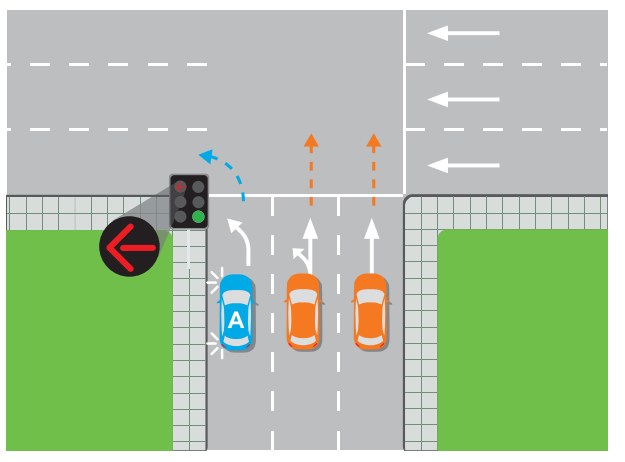
Not turn left.
Turn left if the road is clear.
Turn left after slowing down.
Turn left if no pedestrians are present.
A red arrow means you must not turn in that direction, even if other traffic lights are green.
If your car breaks down in a dangerous position, you must:
Stay inside and call a friend.
Leave the car and walk for help.
Flash your high beams continuously.
Turn on your hazard lights.
Activating hazard lights immediately warns other drivers of your stationary vehicle in a dangerous position, reducing the risk of a collision and improving safety.